Softenger

Softenger India Pvt. Ltd. Logo

Grid Modernization in the Energy & Utilities Sector: Building a Resilient, Secure, and Intelligent Power Infrastructure

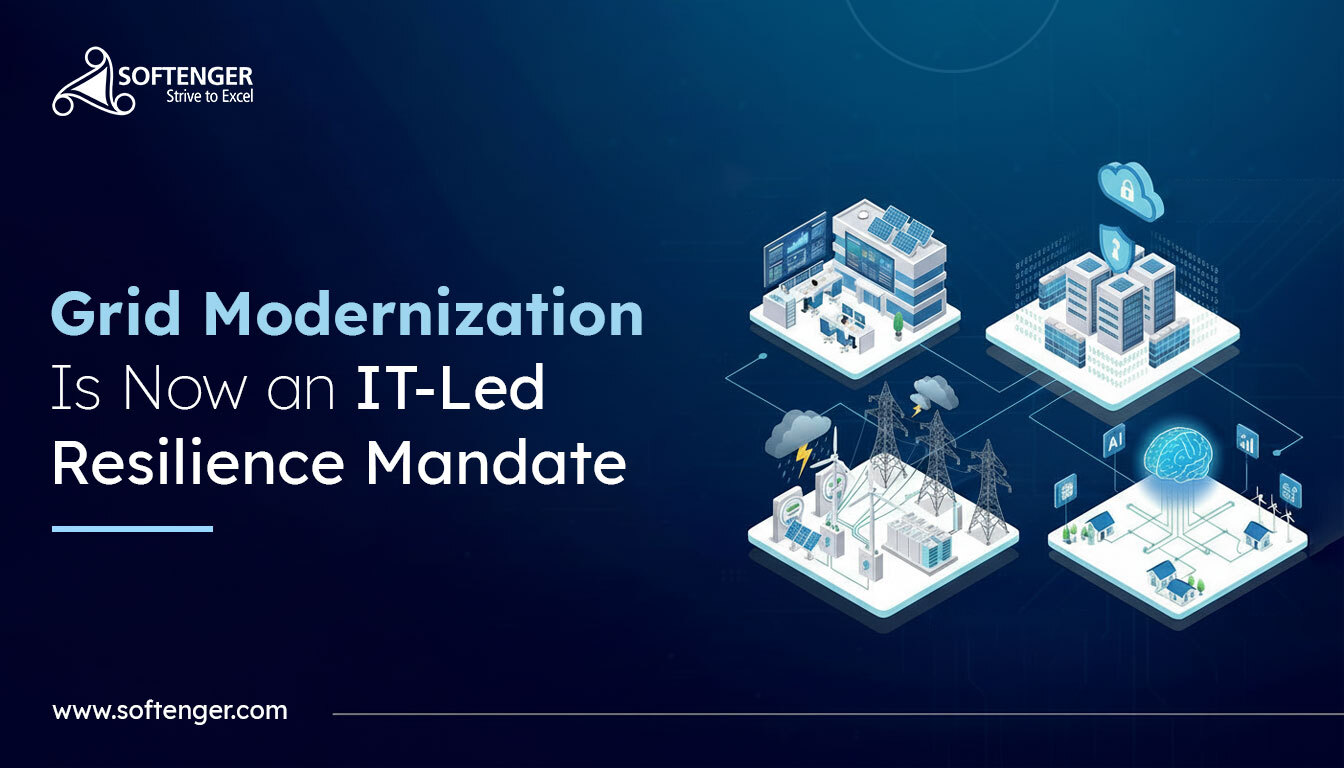
Grid Modernization Is Now an IT-Led Resilience Mandate

The U.S. energy and utilities sector is undergoing one of the most significant transformations in its history. Aging grid infrastructure, accelerating renewable integration, climate-driven disruptions, and escalating cyber threats are forcing utilities to fundamentally rethink how power is generated, distributed, and managed.
At the center of this shift is grid modernization—the move toward digitally enabled, resilient, and intelligent energy infrastructure.
For IT Infrastructure Leaders, CIOs, IT Directors, and CISOs, grid modernization is no longer an engineering-only or operations-led initiative. It has become a strategic IT responsibility, where decisions around infrastructure architecture, availability, cybersecurity, and data platforms directly determine grid reliability, regulatory compliance, and public safety outcomes.
This article explores the IT-driven forces shaping grid modernization in U.S. utilities and why modern, security-first infrastructure is now foundational to grid resilience.

Why IT Infrastructure Leaders Own Grid Modernization Today

Traditional power grids were designed for centralized generation, predictable load patterns, and minimal digital dependency. Today’s grid environment is fundamentally different:
  • Distributed Energy Resources (DERs) such as solar, wind, and battery storage
  • Bidirectional power flows across transmission and distribution
  • Real-time demand variability driven by EVs and smart devices
  • Extreme weather events impacting uptime and service continuity
  • Sophisticated cyber threats targeting critical infrastructure
As grid complexity shifts from the physical layer to the digital layer, IT now owns grid resilience.
Modern grid operations depend on:
  • Always-on networks with strict availability requirements
  • Real-time telemetry and analytics
  • Real-time demand variability driven by EVs and smart devices
  • Hybrid IT architectures spanning edge, data center, and cloud
  • Security frameworks that protect converged IT and OT environments
Grid modernization is no longer about incremental upgrades—it is a continuous, IT-led transformation that underpins operational stability.

Key Grid Modernization Trends Shaping U.S. Utilities

Digital Grid Infrastructure and Advanced Monitoring

Modern grids rely on intelligent digital infrastructure to deliver real-time visibility across generation, transmission, and distribution systems.
Core enablers include:
  • Smart sensors and Intelligent Electronic Devices (IEDs)
  • Advanced Metering Infrastructure (AMI)
  • Real-time data ingestion and analytics platforms
  • High-availability networks governed by strict SLAs
For IT infrastructure leaders, this significantly raises backend requirements for compute, storage, networking, and observability. Without a resilient IT foundation, utilities face delayed fault detection, limited situational awareness, and longer outage durations.

Data-Driven Grid Operations and Analytics

Grid modernization dramatically increases data volumes—from substations, control systems, field devices, and customer endpoints. Utilities are increasingly using:
  • Predictive analytics for asset health and maintenance
  • AI-driven load forecasting and demand response
  • Event correlation to accelerate outage detection and restoration
This model requires:
  • High-performance storage platforms
  • Secure data pipelines between OT and IT environments
  • Hybrid architectures combining on-prem systems with cloud analytics
The challenge for IT leaders is enabling scale and intelligence without introducing latency, reliability, or compliance risk.

Hybrid IT and Cloud Adoption in Utilities

Cloud adoption across the energy sector continues to grow, driven by scalability, agility, and cost optimization.
Common cloud use cases include:
  • H3: Grid analytics and simulation
  • Disaster recovery and backup
  • Application modernization
  • Centralized infrastructure management
However, due to regulatory constraints, safety considerations, and real-time operational requirements, most utilities operate in hybrid IT environments, not cloud-only models.
Latency-sensitive workloads—such as real-time control, protection systems, and substation operations—must remain at the edge or on-premises, while cloud platforms support analytics, optimization, and resilience use cases.
Typical hybrid IT reference architecture:
  • Edge and substation systems handling real-time operations
  • Utility data centers supporting core applications and control platforms
  • Cloud environments enabling analytics, DR, and scalability
This architecture places a premium on orchestration, workload placement, and secure integration.

Cybersecurity as a Foundational Grid Capability

As grids become more connected, the attack surface expands.
Utilities face threats including:
  • Ransomware targeting OT environments
  • Nation-state attacks on critical infrastructure
  • Insider threats and configuration drift
  • Supply chain vulnerabilities
Modern grid infrastructure must be designed with a security-first mindset, including:
  • Zero Trust architectures
  • Continuous vulnerability management
  • SOC-driven detection and response
  • Compliance with NERC CIP, ISO, and related frameworks
Typical IT vs OT cybersecurity ownership model:
  • IT teams: Network security, identity, cloud security, SOC operations
  • OT teams: Device integrity, control system availability, process safety
  • Shared responsibility: Incident response, monitoring, governance
Cyber resilience is now inseparable from grid reliability.

Automation and Remote Infrastructure Management

With geographically distributed assets and limited on-site staffing, utilities are increasingly adopting automation and remote infrastructure management.
Key benefits include:
  • Faster incident detection and resolution
  • Reduced operational overhead
  • Improved SLA adherence
  • Proactive maintenance instead of reactive response
Automation, AI-driven alerts, and centralized operations centers enable utilities to manage complex environments at scale while maintaining reliability.

RTO and RPO Expectations for Grid-Critical Systems

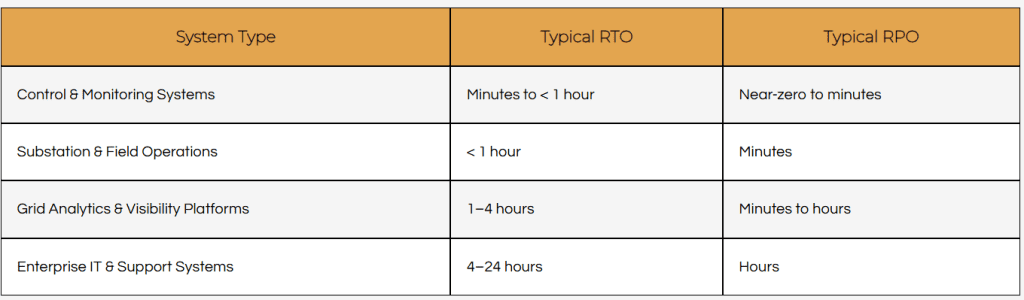
Modern grid environments require clearly defined recovery objectives aligned to operational risk.
System Type Typical RTO Typical RPO
Control & Monitoring Systems
Minutes to < 1 hour
Near-zero to minutes
Substation & Field Operations
< 1 hour
Minutes
Grid Analytics & Visibility Platforms
1–4 hours
Minutes to hours
Enterprise IT & Support Systems
4–24 hours
Hours
Meeting these targets requires resilient infrastructure, automation, and continuously tested recovery strategies.

Mini Case Example: Modernizing Grid Infrastructure Without Disruption

A large U.S.-based electric utility operating across multiple states faced increasing outage durations and limited real-time visibility due to aging infrastructure.
Key challenges included:
  • Legacy substation environments with minimal telemetry
  • Fragmented IT and OT data platforms
  • Manual incident response processes
  • Growing cybersecurity and compliance pressure
The utility adopted a phased grid modernization strategy:
  • Implemented digital monitoring across substations
  • Introduced a hybrid IT model connecting data centers and cloud platforms
  • Centralized monitoring with automation and analytics
  • Strengthened cybersecurity controls aligned with regulatory standards
The result was faster outage detection, improved restoration times, and a stronger cyber resilience posture—achieved without disrupting ongoing grid operations.

The IT Leadership Challenge: Progress Without Risk

While the benefits of grid modernization are clear, execution remains complex. IT leaders must balance:
  • Legacy systems with modern platforms
  • Reliability with innovation
  • Compliance with agility
  • Cost optimization with performance
Grid modernization is not a one-time initiative—it is an ongoing operational discipline requiring continuous optimization and governance.

How Strategic IT Infrastructure Support Enables Grid Modernization

Successful grid modernization consistently rests on four IT pillars:

Resilient Infrastructure Architecture

  • High-availability systems
  • Redundancy and disaster recovery
  • Performance aligned to grid SLAs
Security-First Design
  • Integrated IT and OT security controls
  • Continuous monitoring and SOC integration
  • Compliance-ready environments
Scalable Hybrid IT Operations
  • Secure workload placement across edge, data center, and cloud
  • Governance and orchestration
  • Cost and performance optimization
Continuous Operations and Optimization
  • 24×7 monitoring and support
  • Automation-driven incident response
  • Ongoing modernization aligned to grid evolution

Softenger’s Perspective: Supporting Grid Modernization Programs

With over 25 years of experience supporting complex, mission-critical IT environments, Softenger works with organizations to strengthen infrastructure resilience through its AOTS approach:
  • Advice: Assessing legacy environments and defining modernization roadmaps
  • Optimize: Improving availability, performance, and cost efficiency
  • Transform: Enabling secure hybrid infrastructure models
  • Support: Providing continuous infrastructure and security operations
Softenger’s capabilities across IT Infrastructure, Cybersecurity, Cloud, and Application Support are aligned to the operational realities of regulated, high-availability environments such as energy and utilities.

Looking Ahead: IT as the Backbone of the Modern Grid

Grid modernization is no longer optional—it is essential to reliability, sustainability, and national resilience.
As energy systems become more distributed and data-driven, IT Infrastructure Leaders will increasingly define how safely and efficiently power is delivered.
Utilities that invest in resilient, secure, and scalable IT foundations today will be best positioned to meet tomorrow’s energy demands with confidence.

Request a Remote Infrastructure Resilience Consultation

Build a roadmap for IT/OT convergence with 99.9% uptime and automated compliance.

Insights, analysis and research

Scroll to Top