
Securing the Future of Utilities: IT/OT Convergence and Cybersecurity for...
Read More
The Draft Digital Personal Data Protection Rules, 2025:

On January 3, 2025, the Ministry of Electronics and Information Technology introduced the Draft Digital Personal Data Protection Rules, 2025 for public consultation until February 18, 2025.
How Sustainable Hotel Technology Is Transforming Hospitality: The Rise of Energy-Aware IT Infrastructure
The Sustainability Imperative Reshaping Hotel IT Strategy
Sustainability has become a board-level priority across the U.S. hospitality sector. Industry analyses from AHLA, STR, and the U.S. Green Building Council show a consistent trend: hotels are increasing investments in energy-efficient building systems, cloud modernization, and digital infrastructure that reduces environmental impact. In fact, energy represents one of the largest controllable operating expenses for hotels, with HVAC alone accounting for up to 50% of a property’s consumption.
For hotel CIOs, CTOs, and Infrastructure Directors, this shift introduces new expectations: IT strategy must now directly contribute to energy efficiency, ESG reporting accuracy, and long-term operational resilience. Modern hospitality IT stacks are evaluated not only on performance and uptime, but on power efficiency, automation maturity, carbon visibility, and the ability to standardize sustainability insights across properties.
As sustainability moves from marketing rhetoric to measurable operational discipline, energy-aware IT infrastructure is emerging as a foundational capability for future-proof hotel operations.
Why Sustainability Is Driving a New Wave of IT Adoption in Hospitality
1. Energy Costs Directly Influence GOP and Margin Stability
Hotels operate continuous, high-load environments guest rooms, kitchens, laundry, conference spaces, and pools. Systems such as HVAC, building automation, surveillance, property management, IoT devices, and digital guest services all rely on robust IT connectivity.
CIOs increasingly look to cloud-enabled automation, IoT orchestration, and real-time analytics to reduce kWh usage per occupied room, optimize asset runtimes, and flatten peak loads.
2. ESG Compliance and Investor Expectations Are Accelerating
Publicly traded hospitality groups increasingly report sustainability metrics aligned to GRI, SASB, and UN SDG frameworks. Mandates now include:
- Carbon reduction progress
- Renewable electricity usage
- Data center and digital system efficiency
- Scope 1–3 emissions transparency
3. IT Procurement Now Includes Sustainability Evaluation Criteria
Hotel technology stacks are assessed on KPIs such as:
- Power Usage Effectiveness (PUE)
- kWh/occupied room by system
- Carbon intensity per cloud workload
- Storage and compute optimization ratios
- Automation-driven energy savings
The Rise of Energy-Aware IT Infrastructure in Hotels
Smart Building Systems Are Becoming Standard
Across the U.S. hospitality market, hotels are deploying smart technologies such as:
- Intelligent HVAC optimization
- Occupancy-driven lighting and controls
- IoT-based automation workflows
- Smart metering and submetering
- Predictive maintenance algorithms
Cloud Platforms Now Support Carbon-Aware Operations
Cloud providers increasingly offer sustainability-enabling features such as:
- Renewable-powered data centers
- Carbon-aware workload scheduling
- Automated rightsizing and autoscaling
- Storage tiering to reduce energy waste
For hotels pursuing net-zero roadmaps, the cloud has become a strategic lever for reducing digital emissions.
Infrastructure Investments Must Demonstrate Measurable Environmental Returns
CIOs expect quantified outcomes, including:
- Verified kWh reduction
- Lower carbon intensity per occupied room
- Improved PUE of on-prem or hybrid systems
- Automated ESG reporting accuracy
How Energy-Aware Infrastructure Actually Works
To help CIOs design environmentally efficient hotel ecosystems, here are three concrete technical models shaping modern sustainable hospitality.
1. Smart HVAC Orchestration Through Edge + IoT + Cloud
Hotels are deploying edge gateways connected to IoT sensors (temperature, humidity, occupancy, CO₂) that feed into:
- BACnet -compatible HVAC controllers
- Cloud analytics engines
- Automated policy engines for load balancing
2. Cloud Workload Optimization for Lower Digital Energy Demand
Cloud sustainability engineering enables:
- Automated scaling to avoid idle compute
- Rightsizing of VMs and containers
- Cold storage tiering for infrequent data
- Carbon-aware workload scheduling based on real-time grid intensity
3. Cross-Property ESG Data Architecture
Large hotel groups require consistent environmental reporting across dozens or hundreds of locations. This architecture often includes:
- Edge gateway ingestion for building systems
- Cloud analytics pipelines aggregating energy, water, waste, and carbon insights
- Unified ESG dashboards aligned to GRI/SASB frameworks
- API interoperability between building management, hotel operations, and corporate ESG systems
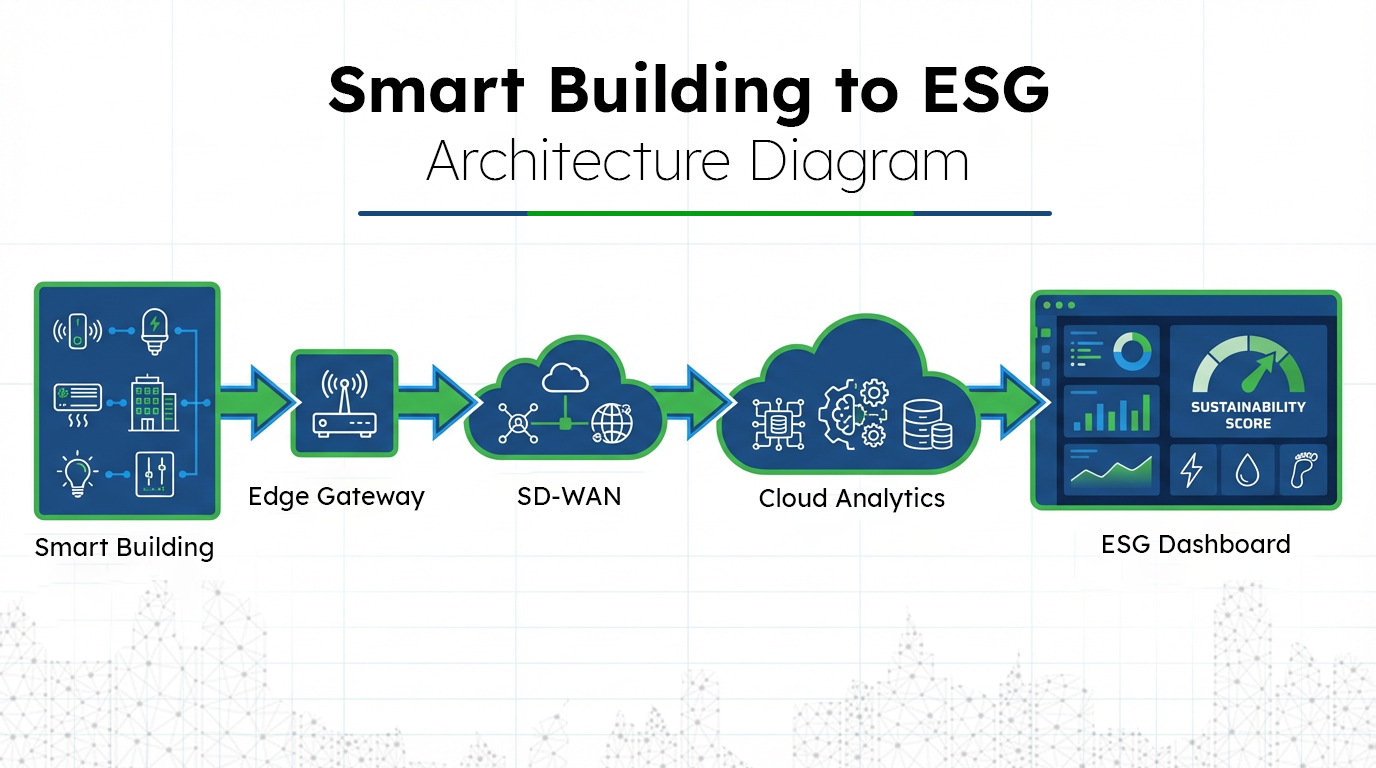
This approach gives CIOs centralized visibility and reduces reporting errors—supporting both compliance and investor communications.
Industry Trends Reinforcing the Move Toward Sustainable IT
Recent insights from AHLA, HospitalityNet, Revfine, and the Green Building Council highlight:
1. Sustainability as a Top Technology Driver
Green IT, smart energy management, and cloud modernization rank among the fastest-growing hotel tech investment categories.
2. ESG Pressure from Investors and Regulators
Hospitality companies must provide quantifiable, audit-ready evidence—not narrative summaries.
3. Converged Infrastructure Models
LEED, Energy Star, and GBC frameworks increasingly evaluate the efficiency of building automation and IT systems together, not in isolation.
What Hotel C-Suite Leaders Want from IT Vendors Now
Across CIOs, CTOs, and Infrastructure Directors, expectations include:
- Quantified sustainability outcomes (kWh, carbon saved, PUE improvements)
- Integration-ready ecosystems across HVAC, IoT, cloud, and building controls
- Green cloud and data center strategies
- ESG reporting support aligned with GRI and SASB
- Operational resilience measured by RTO/RPO targets, uptime SLAs, and SOC-backed infrastructure security
How Softenger Enables Sustainable Hospitality Through Infrastructure Excellence
Softenger brings 25+ years of global IT expertise across India, Singapore, Malaysia, UAE, and North America. Using the AOTS framework (Advice, Optimize, Transform, Support), Softenger helps hotels modernize digital infrastructure with sustainability, resilience, and compliance at the core.
Key Differentiators for Hotel CIOs
- Energy-efficient cloud and data center optimization aligned to carbon reduction targets
- Infrastructure automation and 24/7 monitoring to minimize energy waste
- Cybersecurity and SOC services safeguarding IoT and smart building ecosystems
- ESG-ready reporting tools that centralize cross-property energy and carbon insights
- Hybrid IT architectures enabling resilient, efficient, and scalable hotel operations
Frequently Asked Questions on AI-Ready Hospitality Infrastructure
AI systems rely on fast, secure, and integrated data environments. Legacy PMS or on-prem servers can’t process real-time analytics or IoT data efficiently. Modern, cloud-first infrastructure delivers scalable compute, API-based integration, and observability enabling AI to predict demand, personalize guest experiences, and optimize operations with minimal latency.
Red flags include fragmented PMS and CRM systems, manual data reconciliation, inconsistent guest profiles, and frequent downtime. If AI pilots stall or new apps require custom code, orchestration and scalability are lacking. Hotels at Level 1–2 in the Readiness Framework typically face these issues.
→ [Download the Checklist] to assess your AI readiness.
API orchestration is the digital nervous system connecting PMS, CRM, RMS, and IoT systems. It standardizes data flow, keeping latency below 100 ms and eliminating silos. This enables AI to act on live data powering predictive maintenance, dynamic pricing, and hyper-personalized guest experiences across all properties.
RIM delivers centralized, SLA-driven oversight of multi-property environments. With 24 × 7 monitoring, self-healing automation, and observability, it ensures 99.99 % uptime and compliance with GDPR and PCI-DSS. RIM transforms infrastructure into a predictive, continuously optimized operation supporting AI scalability.
Start with an Infrastructure Readiness Assessment to identify bottlenecks, integration gaps, and security risks. Move toward hybrid, API-driven architecture with observability and CSPM layers. Partner with modernization experts like Softenger who deliver SLA-based RIM and transformation frameworks ensuring measurable ROI and faster AI deployment.
AI-ready infrastructure can deliver 25–40 % efficiency gains, 30 % downtime reduction, and 10–17 % higher occupancy through predictive analytics and automation. ( Deloitte, PwC, McKinsey).
Build an Energy-Aware Hospitality Infrastructure
Explore how next-gen IT, automation, and sustainability analytics can transform multi-property operations into low-carbon, high-efficiency environments.
Insights, analysis and research
Why Remote and Centralized Device Management Is Transforming IT Operations in the Hospitality Industry
Why Remote and Centralized Device Management Is Transforming IT Operations...
Read More
Grid Modernization in the Energy & Utilities Sector: Building a Resilient, Secure, and Intelligent Power Infrastructure
Grid Modernization in the Energy & Utilities Sector: Building a...
Read More
-
About UsAbout Us
-
Case StudiesCase Studies
-
BlogsBlogs
-
VacanciesVacancies
-
IT InfrastructureIT Infrastructure
-
Cyber SecurityCyber Security
-
Cloud SupportCloud Support
-
Application & Product SupportApplication & Product Support
Join Our Newletter
© Softenger 2026. All Rights Reserved
-
Privacy PolicyPrivacy Policy
-
Terms of UseTerms of Use
-
AccessibilityAccessibility