


Singapore BFSI Cloud Cost Optimisation & AI Trends 2026: FinOps for Sustainable Scale
Budget 2025 Is Now Live — Are Singapore BFSI Leaders Capturing the ROI?
Singapore’s Budget 2025 doubled down on AI and enterprise compute — and in 2026, the Enterprise Compute Initiative is deployed and operational. But BFSI leaders face a dual challenge: capitalizing on subsidized AI infrastructure while maintaining strict cost controls, MAS compliance, and audit-ready spending governance.
FinOps and cloud cost optimization allow Singapore banks and insurers to scale AI-driven workloads while keeping IT infrastructure spending transparent, predictable, and compliant. This article explores the top cloud cost drivers for Singapore BFSI in 2026, a 6-step FinOps playbook, compliance obligations, real-world case data, and a cloud readiness checklist.
- Why Budget 2025’s Enterprise Compute Initiative matters for BFSI cloud strategy in 2026
- The 3 top cloud cost drivers for Singapore BFSI — including the 2026 GenAI inference surge
- The 6-step FinOps playbook adapted for Singapore’s BFSI regulatory environment
- How AI itself reduces cloud costs — predictive scaling, scheduling, and waste elimination
- MAS compliance and risk factors that shape every cloud spend decision
- Real-world case data: DBS and open-source DB modernization outcomes
- Free downloads: Cloud Cost Audit Dashboard and FinOps Readiness Assessment
- 4-step action plan for CIOs to act on Budget 2025 incentives before the window closes
Why Budget 2025 Still Matters for BFSI Cloud Strategy in 2026
Budget 2025 signaled Singapore’s commitment to becoming an AI-first economy — and in 2026, those commitments are operational. The Enterprise Compute Initiative (ECI) with more than S$150 million in funding is subsidizing access to high-performance compute resources for regulated industries including BFSI. IMDA advisory services are guiding deployment. The question for BFSI CIOs in 2026 is not whether to access these incentives — it’s whether their FinOps governance is mature enough to capture the ROI without creating compliance exposure.
Budget 2025’s incentives target innovation — but BFSI CIOs must ensure that scaling AI workloads through ECI does not create uncontrolled spending or MAS compliance gaps. Access without governance is exposure.
The 3 Top Cloud Cost Drivers for Singapore BFSI in 2026
Without visibility and governance, these three cost drivers can increase annual IT infrastructure spend by 25–40% — eroding the very savings that Budget 2025 incentives are designed to enable.
Training large AI models and running inference pipelines consume vast amounts of compute. Flexera’s 2025 State of the Cloud found that 47% of BFSI firms cite AI workloads as their top driver of rising cloud spend. GPU-driven training jobs can inflate monthly OpEx by 30–40% without proper scheduling or rightsizing.
BFSI workloads generate sensitive, high-volume data. MAS Notice 644 and PDPC guidelines require long-term storage of logs, backups, and sensitive financial data — often increasing storage costs by 8–12%. Data egress fees for cross-region transfers and encryption overheads compound the baseline storage cost.
Many BFSI institutions adopt multi-cloud strategies for resilience. But managing licensing fees, overlapping SLAs, and underutilized reserved instances leads to double spend. IDC notes that multi-cloud inefficiency can add 15–25% overhead if left unchecked.
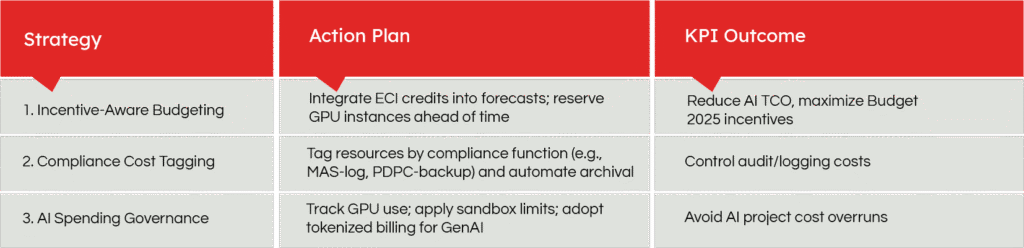
The 6-Step FinOps Playbook Adapted for Singapore BFSI
FinOps isn’t just about reducing spend — it’s about building accountability across finance, IT, and compliance teams. In 2026, the Singapore MAS outsourcing framework and PDPC data governance requirements make FinOps governance a compliance obligation, not just a best practice. Here is the playbook adapted for Singapore BFSI:
How AI Reduces Cloud Costs — Not Just Raises Them
AI workloads drive cost increases — but AI also plays a central role in optimizing cloud usage. According to IDC, AI-enabled cloud optimization delivers 15–20% additional savings beyond traditional FinOps practices. In 2026, these capabilities are available as standard features in major cloud platforms rather than requiring specialist tooling.
Compliance & Risk Factors That Shape Every BFSI Cloud Spend Decision
BFSI organizations must ensure that cloud optimization decisions align with compliance obligations. In Singapore, three requirements directly constrain how costs can be optimized — and each requires FinOps governance to be compliance-aware, not just cost-aware.
Cloud Readiness for 2026: Are Your Controls in Place?
To leverage Budget 2025 ECI credits while maintaining cost control and MAS compliance, Singapore BFSI firms should validate the following six controls. Each represents a prerequisite for sustainable AI-driven cloud scaling in 2026.
Singapore BFSI Cloud Readiness Checklist — 2026
- 24×7 cost visibility dashboards with workload-level granularity — not just account-level billing summaries
- SLA-based infrastructure costing with separation of compliance overhead from operational spend
- Enterprise-wide FinOps policy with cross-functional Council (IT · finance · compliance) and assigned ownership
- AI workload monitoring and scheduling — including GenAI inference cost tracking with token-level attribution
- Vendor negotiation readiness — reserved instance commitments reviewed quarterly, not at annual renewal only
- Audit-ready cost attribution models mapped to MAS TRM categories — ready for regulatory review without manual assembly
Singapore BFSI Cloud Transformation: Documented Outcomes
These two cases demonstrate that cost optimization and modernization in Singapore BFSI are proven and measurable — not aspirational. Both were enabled by Singapore’s regulatory clarity and MAS sandbox framework, which made open-source and cloud-native architectures viable for financial institutions.
DBS migrated to a hybrid multi-cloud model using Kubernetes and in-house orchestration — reducing infrastructure costs and dramatically shrinking its on-premises footprint while accelerating application delivery velocity.
A Singapore BFSI institution modernized database infrastructure via open-source MariaDB on containers — leveraging MAS sandbox clarity to make secure open-source viable for non-core workloads. Simplified monitoring on compliance datasets reduced audit preparation overhead significantly.
Singapore’s regulatory clarity — MAS sandbox and PDPC — made secure open-source viable for non-core workloads.
Singapore FinOps Toolkit — Free Downloads for BFSI CIOs
Two downloadable assets built specifically for Singapore BFSI leaders: a cloud cost audit dashboard template and a FinOps readiness self-assessment. Both tools include MAS-aware compliance tagging frameworks and GPU cost tracking capabilities for GenAI workloads.
Cloud vs. Legacy: Smart Tech Investment Checklist for Singapore BFSI CIOs
Decision framework for evaluating cloud migration vs. legacy maintenance costs — with MAS compliance cost overlays and ECI eligibility validation criteria.
Download the Checklist →Singapore Cloud Cost Relief Guide — BFSI CIO Brief
FinOps readiness self-assessment covering tagging maturity, governance structure, AI workload tracking, and MAS compliance audit readiness — scored and benchmarked.
Download the Guide →Next Steps for Singapore BFSI CIOs: Activate Budget 2025 Value Now
Budget 2025 incentive windows are not indefinite. BFSI CIOs who move in 2026 can capture ECI credits and establish FinOps governance before GenAI inference costs compound. Here is the prioritized action sequence.
Frequently Asked Questions on Singapore BFSI Cloud Cost Optimization
-
FinOps is the discipline of bringing financial accountability to cloud spending. For Singapore BFSI firms, it ensures cloud cost optimization aligns with MAS compliance, budgeting, and AI innovation goals — with finance, IT, and compliance teams sharing accountability for every dollar of cloud spend. In 2026, MAS outsourcing framework requirements make cross-team FinOps governance a compliance obligation, not just a best practice.
-
Budget 2025’s S$150M Enterprise Compute Initiative is now deployed and operational in 2026. Singapore BFSI companies can access subsidized GPU clusters and AI-ready cloud infrastructure through IMDA — but must pair this access with FinOps governance to avoid uncontrolled OpEx growth. BFSI CIOs should validate ECI eligibility and pre-register usage in 2026 forecasts before incentive windows close.
-
Key cost drivers include AI training and inference workloads (particularly GenAI inference in 2026, which has surpassed training as the primary concern), compliance-driven storage costs under MAS Notice 644 and PDPC guidelines (adding 8–12%), and multi-cloud vendor complexity (adding 15–25% overhead when unmanaged). Without optimization, these can increase annual IT infrastructure costs by 25–40%.
-
Both. While AI workloads raise compute spending — particularly GenAI inference running 24/7 — AI-driven optimization such as predictive autoscaling and intelligent workload scheduling can deliver up to 20% additional savings beyond traditional FinOps practices (IDC). In 2026, these capabilities are standard features in major cloud platforms rather than requiring specialist tooling.
-
Industry benchmarks from Flexera and IDC suggest BFSI firms applying FinOps can achieve 10–50% savings, depending on maturity. Achievable targets: 30% savings on total cloud spend while enabling AI innovation aligned with Budget 2025. A tailored Singapore BFSI cloud cost audit is essential to validate the specific opportunity for your organization’s cloud portfolio and regulatory profile.
Achieve 30–50% cloud savings while enabling AI innovation
Softenger enables 24×7 cloud operations, FinOps governance, and infrastructure optimization for Singapore’s BFSI sector — with MAS-aware compliance models, region-based delivery teams, and deep hyperscaler partnerships.