

Clinical IT that keeps
pace with patient care — every hour, every site.
Softenger delivers 24/7 remote IT infrastructure management purpose-built for healthcare and pharmaceutical enterprises — covering HIS, EHR, PACS, laboratory systems, HIPAA and 21 CFR compliance, SOC security, cloud/hybrid environments, and digital health platforms. One managed service. One SLA. Every hospital, every lab, every shift. ISO 27001:2022 certified.
When clinical IT fails,
patient care is the first casualty.
Healthcare organisations are among the most ransomware-targeted sectors globally
Hospitals, clinics, and pharma enterprises face persistent ransomware attacks targeting patient data and clinical operations. A successful attack doesn’t only expose PHI — it can shut down clinical workflows, delay treatments, and trigger simultaneous regulatory investigations under HIPAA and GDPR.
Clinical system downtime directly impacts patient care — there is no acceptable maintenance window
EHR, HIS, PACS, and laboratory systems cannot tolerate the planned downtime windows that corporate IT accepts as routine. Clinical workflows — diagnostics, prescriptions, patient scheduling, and surgical preparation — depend on continuous system availability.
Legacy clinical systems co-existing with digital health platforms creates unmonitored integration gaps
Most healthcare IT environments are deeply hybrid — legacy on-premises HIS and PACS co-existing with cloud-hosted telehealth platforms, IoMT devices, and SaaS clinical applications.
HIPAA, GDPR, 21 CFR Part 11, and ISO 13485 compliance obligations overlap across every jurisdiction
Healthcare and pharma enterprises face simultaneously applicable regulatory frameworks — HIPAA for PHI in the US, GDPR for data protection across Europe, 21 CFR Part 11 for electronic records in FDA-regulated pharma, and ISO 13485 for medical device quality management.
Digital health scaling — telemedicine, IoMT, and remote monitoring demand IT flexibility that legacy models can’t provide
Telehealth adoption, remote patient monitoring devices, and digital health platform deployments all require IT infrastructure that scales securely and rapidly.
Three mandates that define healthcare IT — and why generic managed IT misses all three.
Healthcare IT management is not about keeping servers running. It is about three distinct operational mandates that generic managed IT providers — designed for office-based corporate environments — are structurally unsuited to fulfil.
The first is clinical continuity: the IT systems managing patient records, diagnostic imaging, lab results, and clinical workflows must match the uptime expectations of a hospital’s clinical operations — not the uptime expectations of a corporate HR system. The second is compliance and security: the regulatory framework around healthcare data — HIPAA, GDPR, 21 CFR Part 11 — requires continuous IT monitoring and documentation, not an audit-season activity. The third is integration management: the data pipelines between HIS, EHR, PACS, lab systems, and cloud-hosted digital health platforms are the clinical data backbone, and their health must be monitored as carefully as the systems themselves.
Softenger’s healthcare RIM is built around all three mandates simultaneously — not adapted from a model designed for enterprise IT applied to a hospital.
Clinical Systems Operations
24/7 NOC monitoring of HIS, EHR, PACS, LIS, and all supporting clinical infrastructure under clinical-critical SLA tiers. Proactive anomaly detection before healthcare operations are impacted — centralized visibility across all facilities.
Healthcare Security & Compliance Operations
24/7 SOC coverage with healthcare-sector threat intelligence. HIPAA, GDPR, and 21 CFR Part 11 compliance monitoring embedded as system outputs from day one — PHI access monitoring, audit trail integrity, and continuous regulatory posture.
Healthcare Infrastructure & Business Continuity
Multi-cloud and hybrid infrastructure, data center operations, WAN across facilities, and disaster recovery with clinical-aligned RPO/RTO. Digital health platform infrastructure managed as clinical-critical environments, not generic cloud workloads.
Three service tiers. Every healthcare IT need covered.
Softenger’s healthcare RIM operates across three distinct service domains — each with its own SLA model, compliance requirements, and operational discipline. Together they cover the full clinical and pharma IT stack from bedside to cloud.
Clinical Systems Operations
Softenger’s clinical NOC provides 24/7 monitoring of all patient-facing and clinician-facing IT systems with SLA tiers calibrated to the operational urgency of healthcare — not corporate IT service windows. A PACS outage during an active imaging session is a P1 event requiring an immediate response, not a standard service desk ticket processed in queue order.
Multi-site hospital groups, clinic networks, and diagnostic centre chains where HIS, EHR, PACS, or lab system downtime directly impacts patient care delivery and clinical staff operations — and where reactive IT support is an unacceptable operating model.
- 99.99% uptime on HIS, EHR, PACS, and clinical-critical systems
- Clinical incidents detected before they reach clinical staff
- 40% faster incident resolution vs. reactive IT support
- Single NOC view across all facilities — no per-site dashboards
- Monthly uptime and incident trend reports
Compliance & Security Operations
Healthcare organisations face a dual compliance and security challenge — simultaneously managing HIPAA PHI obligations, GDPR data protection requirements, 21 CFR Part 11 electronic records rules, and a threat landscape where ransomware groups specifically target clinical systems for maximum ransom leverage. Softenger’s healthcare SOC addresses both with a unified monitoring model built for clinical environments.
Healthcare organisations and pharma enterprises operating across multiple regulatory jurisdictions — where HIPAA, GDPR, and 21 CFR Part 11 apply simultaneously and compliance must be maintained continuously rather than assembled before each audit.
- Continuous HIPAA and GDPR compliance posture — audit-ready always
- PHI access anomalies detected and logged in real time
- 21 CFR audit trail integrity validated continuously
- Healthcare-specific threat detection — ransomware and PHI exfiltration patterns
- Monthly compliance and security posture reports
Infrastructure & Digital Health IT
The infrastructure layer underpins every clinical system and digital health platform in your organisation. Softenger manages on-premises data centers, cloud environments, WAN connectivity across facilities, and — critically — the integration pipelines between clinical systems and digital health platforms, ensuring that clinical data flows reliably from source to clinician in every scenario.
Healthcare groups expanding into digital health, telemedicine, and remote patient monitoring — where cloud-hosted platforms must integrate reliably with on-premises clinical systems and every integration failure carries a patient care consequence.
- Cloud infrastructure optimised for clinical workload patterns and HIPAA requirements
- HIS and EHR integration pipelines monitored end-to-end
- IoMT device networks managed as clinical-critical environments
- DR tested and validated — recovery within clinical operational RTO
- WAN across all facilities — one SLA, consistent quality
The technology stack behind
Softenger’s clinical IT
operations model
Softenger’s healthcare IT operations run on a toolchain assembled specifically for clinical and pharmaceutical environments — integrating enterprise monitoring platforms with clinical-system-aware alert configurations, HIPAA-compliant audit logging, and pharma-sector compliance controls.
Every tool in the stack is configured to the clinical monitoring model developed during the Advise phase. Alert thresholds for HIS and EHR systems reflect clinical workflow patterns. PHI access monitoring uses healthcare-specific behavioural baselines. Compliance logging satisfies HIPAA audit trail requirements as a system output — not a custom configuration request.
Clinical-system-aware monitoring configuration
Alert thresholds calibrated to clinical workflow patterns — PACS imaging, EHR record access, LIS result delivery — not set to vendor defaults designed for generic enterprise environments.
HIPAA-aligned PHI access monitoring
PHI access events are monitored against clinical workflow baselines. Anomalous access — bulk record downloads, off-hours access to restricted patient data, lateral movement toward PHI repositories — triggers immediate SOC escalation.
Clinical integration pipeline visibility
HL7 FHIR, DICOM, and proprietary clinical integration pipelines monitored end-to-end — message queue health, API latency, and data completeness tracked before failures cascade to clinical workflows.
Six system categories. The full clinical IT stack covered.
Softenger’s healthcare and pharma RIM covers the full technology stack — from bedside clinical systems and imaging infrastructure to pharma R&D platforms and cloud-hosted digital health environments — under one operations model with consistent SLAs and a single escalation path.
Hospital Information & EHR Systems
HIS, EHR/EMR, and patient management system availability monitoring under clinical-critical SLA tiers. Admissions, patient records, clinical documentation, and discharge workflows monitored proactively — incidents detected before clinical staff are affected.
Medical Imaging & Diagnostics
PACS, DICOM, RIS, and teleradiology platform monitoring. Imaging infrastructure availability is treated as clinical-critical — a radiologist waiting for PACS access during a time-sensitive diagnostic session is never a standard service desk ticket.
Laboratory Information Systems
LIS availability, result delivery pipeline health, and lab equipment integration monitoring. Critical result reporting chains — from analyzer to clinician — monitored end-to-end. LIS downtime that delays a critical lab result is a patient safety event, not an IT inconvenience.
Pharma R&D & Manufacturing IT
LIMS, pharma MES, clinical trial management systems, Veeva Vault, regulatory submission platforms, and manufacturing IT monitoring. 21 CFR Part 11 compliant audit logging and electronic record integrity monitoring built into operations from day one.
Healthcare Security & Compliance Operations
24/7 SOC monitoring with healthcare-sector threat intelligence. HIPAA PHI access monitoring, GDPR data protection controls, 21 CFR Part 11 audit trail integrity — all embedded as continuous system outputs, not pre-audit deliverables.
Cloud & Digital Health Infrastructure
HIPAA-compliant cloud infrastructure, telemedicine platform availability, IoMT device network monitoring, patient portal uptime, and digital health API integration health — all managed under the same clinical-critical operations model as on-premises systems.
Outcomes from healthcare engagements
Two documented outcomes from Softenger’s managed IT engagements in healthcare and life sciences environments — showing the operational and financial impact of purpose-built clinical IT operations.
Remote IT Infrastructure built for clinical performance, reliability, and regulatory compliance across distributed hospital operations
A multi-site hospital group operating across Singapore and Malaysia managed clinical IT on a per-hospital model — separate vendors, no centralized monitoring, and reactive incident management that consistently detected HIS and PACS issues after clinical staff reported them. HIPAA and PDPA compliance documentation was manually assembled before each audit cycle, consuming significant IT staff time.
Seamless ITSM and application support for a pharmaceutical enterprise — 99.99% application uptime and 21 CFR Part 11 compliance achieved
A pharmaceutical enterprise with R&D operations across India, Singapore, and the UAE needed enterprise-grade ITSM and managed IT support for their LIMS, Veeva Vault, regulatory submission platforms, and corporate ERP. 21 CFR Part 11 audit trail gaps discovered during an FDA inspection created an urgent remediation requirement alongside the need for ongoing managed IT operations.
Three ways to engage. One clinical-grade standard.
Healthcare and pharma organisations range from single-specialty clinics to multi-country hospital groups and global pharmaceutical enterprises. Softenger's delivery models are designed to match engagement depth to your organisation's clinical scale and IT maturity today.
Dedicated Offshore Support Center
End-to-end managed clinical IT from Softenger's India-based GSC. 24/7 NOC and SOC coverage across all facilities and systems — at 50%+ lower cost than equivalent in-house clinical IT capability.
- 24/7 NOC and SOC across all clinical facilities and systems
- Clinical-critical SLA tiers — HIS, EHR, PACS, LIS prioritised
- 50%+ IT operational cost reduction vs. per-site or in-house model
- HIPAA, GDPR, and 21 CFR compliance monitoring built in from day one
- Scalable as you add facilities, clinical platforms, or digital health services
Hybrid Delivery Model
Offshore GSC for 24/7 monitoring and L1/L2 triage; your clinical IT team retains L3 escalation, clinician liaison, and operational governance. Softenger extends coverage without displacing the clinical knowledge your team carries.
- Offshore NOC/SOC for 24/7 monitoring and L1/L2 incident management
- Your team retains L3 escalation, clinician relationship, vendor governance
- Structured handover protocols and shared clinical incident management
- Compliance monitoring aligned across onshore-offshore operating model
- Designed to augment — not replace — existing clinical IT expertise
On-Demand IT Support
Expert clinical IT support for specific projects — HIPAA gap remediation, EHR implementation support, PACS deployment, 21 CFR compliance projects, or capacity augmentation during digital health platform launches.
- No long-term commitment — engage for defined projects or scopes
- Full healthcare IT expertise across all clinical system domains
- Ideal for HIPAA remediation, EHR migrations, or PACS deployments
- Transparent scope and billing — clear boundaries on coverage
- Clear path to a managed service as clinical IT complexity grows
Advise — Clinical Topology Audit
Infrastructure audit across all facilities — HIS, EHR, PACS, LIS, compliance obligations, and clinical criticality tiering. PHI environment mapping and HIPAA compliance gap identification. Audit output drives the monitoring model.
Optimize & Transform — Configure & Go Live
Clinical-calibrated monitoring rules configured and tested. PHI access monitoring activated. First facility cluster onboarded in parallel with existing coverage, validated, and handed to Softenger NOC before the next begins.
Support — 24/7 Clinical Operations Active
Full 24/7 NOC and SOC operations live. Monthly compliance and uptime reports delivered. Remaining facilities onboarded by cluster. Quarterly AOTS reviews maintain alignment as clinical platforms and digital health services evolve.
Six structural reasons why healthcare organisations choose Softenger over a generic managed IT provider
These are operational and structural realities — built into how Softenger engages, monitors, and responds — that determine whether your clinical IT infrastructure meets the availability and compliance standards patients, clinicians, and regulators simultaneously demand.
Clinical-native operations — HIS and PACS treated as critical patient care infrastructure
Softenger's healthcare RIM classifies clinical systems by their patient care impact — not their technical architecture. An EHR incident is never processed in the same queue as a corporate email server alert. SLA tiers, monitoring rules, and escalation paths reflect the clinical operational context of a healthcare facility.
HIPAA, GDPR, and 21 CFR compliance embedded from day one — never assembled pre-audit
Regulatory compliance controls are configured as infrastructure monitoring outputs from the first day of operations. PHI access logs, 21 CFR audit trails, and GDPR data processing records are always on. Monthly compliance reports are a standard deliverable — not a special request assembled six weeks before an FDA inspection or HIPAA audit.
True 24/7 GSC coverage — India-based operations covering APAC, Middle East, and beyond
Softenger's Global Support Center operates continuous shifts. A PACS outage at 2am during an overnight emergency imaging session reaches an engineer with clinical IT experience in minutes — not when a local IT coordinator arrives on shift. Healthcare cannot accept on-call IT coverage for clinical-critical systems.
Clinical integration pipeline monitoring — HL7, FHIR, DICOM monitored as first-class targets
Softenger monitors the integration pipelines connecting HIS, EHR, PACS, and digital health platforms as primary monitoring targets — not background infrastructure. Clinical data pipeline failures are detected at the source before they cascade to clinical workflows or result in missing patient data during care delivery.
50% IT cost reduction and 40% faster incident resolution — documented outcomes
Consolidating per-facility clinical IT into Softenger's offshore delivery model produces 50%+ cost reduction and 40% faster incident resolution versus reactive IT support models. Healthcare organisations also eliminate the clinical IT knowledge attrition risk — when a senior EHR specialist leaves at the wrong moment in a regulatory review cycle.
25 years of enterprise IT delivery — financial-grade governance applied to clinical compliance
Softenger's 25-year delivery history includes engagements with VISA, Kotak Bank, and Reliance Jio — environments where compliance, security, and 24/7 availability are non-negotiable. The governance discipline from high-compliance financial services environments transfers directly to HIPAA, 21 CFR, and GDPR-regulated healthcare and pharma organisations.
How every healthcare IT engagement runs —without exception.
AOTS — Advise, Optimize, Transform, Support — applied to healthcare IT has specific meaning in each phase. Advise produces a clinical topology audit and PHI environment map — not a generic IT inventory. Optimize configures clinical-calibrated monitoring and HIPAA-aligned access controls before any system goes live. Transform onboards clinical systems in compliance-priority clusters with validation gates. Support operates a 24/7 clinical NOC and SOC with HIPAA Business Associate Agreement compliance built in from the first day of operations.
Advise
Every facility's clinical IT environment is mapped — HIS topology, PACS architecture, PHI data flows, integration dependencies, and applicable regulatory frameworks. The audit produces a clinical criticality model that drives all monitoring decisions and compliance controls that follow.
- Clinical system topology audit — HIS, EHR, PACS, LIS, integrations
- PHI environment mapping — data flows, access controls, segmentation
- Compliance gap assessment — HIPAA, GDPR, 21 CFR Part 11
- Clinical criticality tiering — patient care impact rankings
- Onboarding phasing plan — clinical-critical systems first
A documented clinical topology, PHI environment map, and compliance-aligned monitoring architecture — not a generic healthcare IT template.
Optimize
Monitoring is configured to the clinical model from Advise. EHR alert thresholds, PACS performance baselines, PHI access monitoring rules, and SOC detection profiles are all configured and tested before any facility goes live.
- HIS, EHR, PACS, and LIS monitoring configuration
- HIPAA PHI access monitoring — behavioural baselines set
- 21 CFR Part 11 audit trail logging activated
- Clinical integration pipeline monitoring configured
- Healthcare SOC runbooks — ransomware and PHI exfiltration scenarios
A tested clinical monitoring environment — compliance controls active, SOC detection validated, and clinical SLA tiers confirmed before first live incident.
Transform
Facilities are onboarded in compliance-priority clusters — clinical-critical systems first. Each cluster runs in parallel with existing IT coverage, is validated for clinical uptime and compliance posture, and is handed to Softenger NOC before the next cluster begins.
- Clinical-priority cluster onboarding — HIS/EHR environments first
- Parallel monitoring during transition — no clinical coverage gap
- PHI access simulation — anomalous access scenarios tested pre-handover
- HIPAA compliance validation per cluster before progression
- Clinical staff knowledge transfer — escalation paths explained
All facilities onboarded, validated, and running under defined clinical SLAs — without disruption to active patient care operations during transition.
Support
Softenger's GSC operates your healthcare IT environment continuously — clinical system monitoring, PHI security operations, compliance reporting, and proactive infrastructure health management. Quarterly AOTS reviews ensure the operating model evolves as your clinical platform portfolio and regulatory obligations change.
- 24/7/365 clinical NOC and SOC operations — no business hours
- Clinical incident management — L1–L3 with pre-built runbooks
- Monthly HIPAA, GDPR, and 21 CFR compliance reports
- Proactive clinical infrastructure health reporting
- Quarterly AOTS review — new platforms, new facilities, new regulations
A continuously operated, continuously compliant clinical IT environment — HIPAA posture documented, patient systems monitored, and infrastructure health reported every quarter.
Insights for healthcare &
pharma IT leaders
Explore all insights →
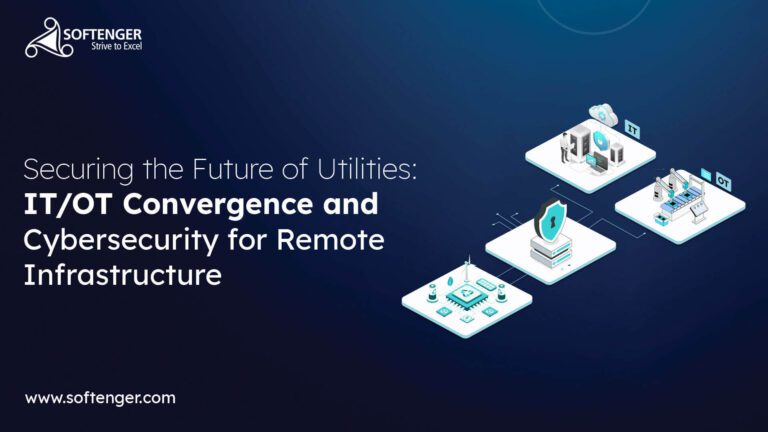
Securing the Future: IT/OT Convergence and Cybersecurity for Remote Infrastructure
The security principles from converged IT/OT environments apply directly to healthcare — where clinical systems, IoMT devices, and corporate IT share network infrastructure and the boundary between them is the primary attack surface for ransomware targeting patient data.
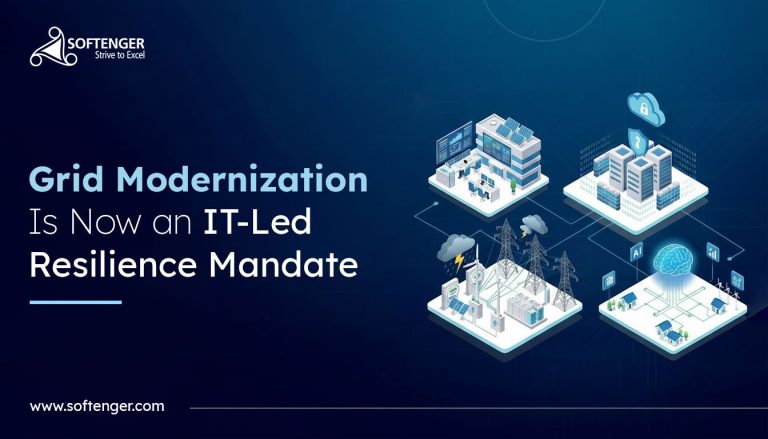
IT-Led Infrastructure Modernization: Building Resilient, Secure Operations at Scale
How enterprises managing complex distributed infrastructure — including multi-site healthcare groups and pharma enterprises — use managed IT frameworks to modernize clinical and research systems without disrupting live operations.
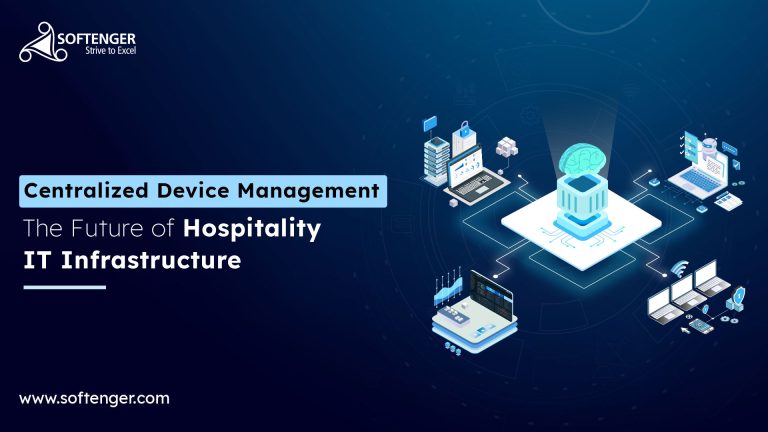
Why Remote and Centralized Device Management Is Transforming IT Operations Across Distributed Infrastructure
The centralized device management model transforming multi-site operations applies with equal force to healthcare enterprises managing clinical workstations, IoMT devices, and imaging systems across geographically distributed hospital networks.
Questions healthcare IT leaders ask
before engaging Softenger
Tell us about your clinical IT environment. We'll show you what managed looks like for healthcare.
A conversation with a Softenger healthcare IT specialist produces a documented clinical topology and compliance assessment — not a vendor pitch. We review your HIS environment, PHI obligations, compliance framework, and current IT operations model, then produce a specific recommendation. No commitment required.
🏥 Request a Healthcare & Pharma IT Assessment
ISO 27001 certified. HIPAA BAA available. Handled securely, never shared.