


UAE enterprises need IT management that keeps pace with how the Gulf operates.
Softenger delivers 24/7 remote IT infrastructure management for UAE and Dubai enterprises — NOC, SOC, CBUAE tech risk compliance, DFSA framework, UAE PDPL, DIFC and ADGM data protection, UAE Cybersecurity Council alignment, and cloud operations. GST-aligned 24/7 coverage. Arabic and English support. One SLA. ISO 27001:2022 certified.
In the UAE, enterprises operate across multiple jurisdictions, regulators, and time zone expectations simultaneously.
These are the operational realities of UAE enterprises managing IT across mainland, DIFC, ADGM, and free zone entities — where CBUAE tech risk requirements, UAE Cybersecurity Council compliance, multi-jurisdiction data protection, and 24/7 GST-aligned coverage all require IT management that was purpose-built for Gulf business context.
UAE operates across mainland, DIFC, and ADGM — each jurisdiction has distinct data protection and regulatory IT obligations
An enterprise with entities in mainland UAE, a financial services operation in DIFC, and an investment management business in ADGM simultaneously faces UAE Federal PDPL, DIFC Data Protection Law 2020, and ADGM Data Protection Regulations — three distinct legal frameworks with partially overlapping but non-identical IT control requirements. Managing compliance for all three with a single generic monitoring template creates gaps that each regulator will find independently.
UAE Cybersecurity Council compliance requires continuous IT monitoring — not annual maturity assessments
The UAE National Cybersecurity Strategy and the UAE Cybersecurity Council’s compliance frameworks — including DESC standards for Dubai entities and NIA for federal entities — require demonstrable, continuous cybersecurity controls. Enterprises that build compliance posture before annual reviews or assessments rather than maintaining it continuously create the gaps between reviews that threat actors and regulators both find most valuable.
UAE’s GST timezone and working week don’t align with European or US IT support models — creating structural coverage gaps
UAE enterprises on the Sunday–Thursday or Monday–Friday working week operate in GST (UTC+4). European IT support providers are asleep for the first 1–2 hours of the UAE working morning. US providers are asleep for most of the UAE working day. Enterprises managing critical infrastructure with support models designed for Western business hours have structural overnight and early-morning coverage gaps that don’t show up on SLA reports — until an incident exposes them.
CBUAE and DFSA tech risk examination preparation consumes IT team capacity and produces repeat findings
Licensed financial institutions under CBUAE and DIFC-regulated entities under DFSA supervision face periodic technology risk examinations with IT governance, risk management, and cybersecurity control requirements. The IT teams that spend 6–8 weeks assembling evidence before each examination cycle consistently find the examiner identifies the same gaps — because the underlying monitoring posture hasn’t changed between cycles, only the evidence presentation has.
UAE cloud adoption requires data residency compliance — AWS me-central-1 and Azure UAE North don’t manage themselves
UAE Federal PDPL, DIFC PDPL, and CBUAE cloud adoption guidelines impose data localisation requirements on specific categories of data. Enterprises adopting AWS me-central-1 (UAE), Azure UAE North, and GCP Middle East often configure cloud workloads without the ongoing monitoring needed to ensure data residency obligations are continuously met — a compliance gap that typically surfaces during examination or following a data access event, not before.
We don’t serve the UAE on European hours and call it 24/7 coverage. We staff for GST from our India GSC.
Most managed IT providers serving UAE enterprises operate from European or US time zones — with account management teams in the region and actual operations delivered during hours that leave UAE morning business coverage to on-call arrangements. For general IT support, that model functions. For UAE enterprises with CBUAE or DFSA regulatory obligations, multi-jurisdiction data protection requirements across mainland, DIFC, and ADGM entities, and critical infrastructure that must be monitored continuously — the model breaks down where it matters most.
Softenger’s India-based Global Support Center operates in IST (UTC+5:30) — which overlaps structurally with GST (UTC+4) in a way that no European or US support center can replicate without dedicated UAE-shift staffing. The entire UAE working day — from the opening of the Dubai market through close of business in Abu Dhabi — is covered within Softenger’s natural daytime operations. An incident at 8am GST on a Sunday morning, at the start of the UAE business week, reaches an engineer in exactly the same timeframe as an incident at 8pm GST.
Combined with deep knowledge of the UAE’s regulatory landscape — CBUAE tech risk requirements, DFSA technology framework for DIFC entities, UAE Federal PDPL, DIFC Data Protection Law, and UAE Cybersecurity Council standards — this model gives UAE enterprises something most IT providers cannot offer: coverage that is genuinely aligned to Gulf business reality, not adapted from a template built for a different hemisphere.
GST-aligned 24/7 coverage from India GSC — structurally, not through on-call arrangements
Softenger’s India GSC shift model means UAE business hours — from the Gulf’s Sunday morning opening to Thursday close, or Monday through Friday under the updated federal week — are covered within standard shift operations. There is no overnight gap, no on-call premium, and no reduction in response quality during UAE morning hours.
GST coverage is structural — not a staffing override for UAE clients.Multi-jurisdiction compliance mapped per entity — mainland, DIFC, and ADGM obligations tracked separately
UAE Federal PDPL, DIFC Data Protection Law, ADGM Data Protection Regulations, and CBUAE/DFSA regulatory obligations for financial entities are mapped to specific IT systems and monitored simultaneously from one compliance layer. Each jurisdiction’s requirements are tracked distinctly — not conflated into a generic data protection template.
Per-entity regulatory mapping — mainland, DIFC, and ADGM tracked separately.CBUAE and DFSA compliance as continuous system outputs — never assembled pre-examination
Technology risk posture documentation, access control monitoring, audit trail integrity, and IT governance evidence for CBUAE-regulated banks and DFSA-licensed DIFC entities are configured as continuous infrastructure outputs from onboarding. The examiner arrives to documentation that is current within 30 days — not assembled under examination pressure.
CBUAE / DFSA posture is a system state — not a pre-examination production.Arabic and English support for UAE user base — bilingual ITSM as standard
UAE enterprise end-user support is delivered in Arabic and English — the working languages of a typical UAE enterprise user base spanning nationals, GCC nationals, South Asian, and Western professional communities. ITSM helpdesk, incident reporting, and user communication are bilingual from onboarding, not configured as an add-on after deployment.
Arabic/English bilingual support — standard in every UAE engagement.Five service pillars. One managed operations model for UAE enterprises.
UAE enterprise IT spans CBUAE-regulated banking infrastructure, DIFC financial services, Oil & Gas operational technology, healthcare systems under DHA and DOH governance, and multi-cloud environments with UAE data residency requirements. Softenger manages all five service pillars — each calibrated to UAE’s specific operational and regulatory context — under one unified operations model.
Three service domains. The full UAE enterprise IT stack — managed from one GST-aligned operations centre.
Softenger consolidates what UAE enterprises typically manage across multiple vendors into a single operations model — with local regulatory knowledge, GST-aligned 24/7 continuity, and one team that speaks UAE’s multi-jurisdiction compliance language fluently.
Infrastructure & Security Operations
24/7 NOC and SOC across all UAE infrastructure — servers, UAE data centers and colocation, cloud workloads, and security monitoring. UAE Cybersecurity Council and DESC standards embedded. UAE-CERT reporting paths active. GST-aligned from the first Sunday morning of engagement.
UAE Compliance & Regulatory Operations
UAE Federal PDPL, DIFC PDPL, ADGM data protection, CBUAE tech risk, DFSA technology framework, and UAE Cybersecurity Council compliance — all monitored simultaneously from one compliance layer. Monthly posture reports covering every applicable jurisdiction are standard deliverables. No pre-examination sprint required.
Cloud, Application & End-User Support
AWS me-central-1, Azure UAE North, and GCP Middle East management with UAE data residency compliance monitoring, bilingual L1–L3 helpdesk in Arabic and English, ITSM operations, app performance monitoring, and patch management — under the same SLA as infrastructure and security, not as a separate support tier.
What UAE enterprises achieve with Softenger’s managed IT model
Outcomes from UAE enterprises operating under CBUAE, DFSA, multi-jurisdiction data protection, and 24/7 GST operational requirements — documented results from managed IT engagements, not projected estimates from a generic offshore IT comparison.
IT Operational Cost Reduction
Consolidating UAE in-house IT or multi-vendor arrangements into Softenger’s GSC delivery model consistently produces 50%+ IT operational cost reduction — while expanding monitoring to 24/7 GST-aligned coverage, adding UAE-specific compliance monitoring, and eliminating the attrition risk where a CBUAE or DIFC compliance-knowledgeable engineer leaves before an examination cycle.
CBUAE & DFSA Compliance Posture Transformation
Continuous tech risk monitoring — configured as system outputs from onboarding — eliminates the compliance gap between examination cycles that produces repeat findings for UAE financial institutions. Monthly technology risk posture reports replace the six-week pre-examination assembly that consumes IT team capacity annually in both DIFC and mainland UAE financial operations.
GST-Aligned 24/7 Coverage
UAE enterprises operating critical IT on European or US support hours gain genuine around-the-clock GST-aligned monitoring — infrastructure anomalies detected before the UAE morning shift arrives at work, not reported to management from the incident log that accumulated overnight before European support came online.
Multi-Jurisdiction Compliance Simplification
UAE enterprises managing Federal PDPL, DIFC PDPL, and ADGM obligations simultaneously gain a single compliance monitoring layer — replacing three separate compliance programmes with one continuous operation that produces evidence for all applicable frameworks from a shared infrastructure monitoring layer.
Every UAE IT engagement follows the same four-phase discipline.
AOTS — Advise, Optimize, Transform, Support — applied to UAE enterprise IT has specific meaning in each phase. Advise is a multi-jurisdiction regulatory audit — mapping your IT environment against CBUAE, DFSA, UAE PDPL, DIFC, ADGM, and UAE Cybersecurity Council obligations before monitoring is configured. Optimize builds UAE-calibrated monitoring rules and activates compliance controls for all applicable frameworks. Transform onboards environments in operational criticality order with parallel monitoring and no coverage gap. Support operates 24/7 in GST with UAE-specific incident runbooks and regulatory notification paths pre-built.
Advise
Softenger maps your entire UAE IT estate against all applicable regulatory frameworks — identifying which systems are in scope for which jurisdiction’s data protection and compliance requirements, and which systems carry the highest operational criticality in UAE business context.
- UAE IT topology audit — five pillars, all entity locations
- Multi-jurisdiction regulatory mapping — Federal PDPL, DIFC PDPL, ADGM, CBUAE, DFSA
- UAE Cybersecurity Council and DESC framework obligation inventory
- UAE cloud data residency requirements — AWS me-central-1, Azure UAE North scope
- Onboarding phasing plan — highest-impact and highest-risk environments first
A documented UAE IT topology and multi-jurisdiction compliance monitoring architecture — per-entity regulatory mapping, operational criticality tiers, and UAE cloud data residency scope defined.
Optimize
Monitoring rules are built from the Advise audit findings — not from generic regional templates. CBUAE tech risk controls, DFSA technology framework monitoring, UAE PDPL personal data access monitoring, UAE Cybersecurity Council framework controls, and UAE cloud data residency monitoring are all configured and validated before go-live.
- Infrastructure monitoring calibrated to UAE operational patterns and GST timezone
- CBUAE and DFSA tech risk monitoring controls activated as system outputs
- UAE PDPL, DIFC PDPL, and ADGM data access monitoring configured per entity
- UAE SOC detection — GCC and UAE-specific threat intelligence feeds integrated
- UAE incident runbooks — CBUAE reporting, UAE-CERT notification, DFSA tech risk escalation paths
A tested, UAE-calibrated monitoring environment — CBUAE, DFSA, and multi-jurisdiction compliance controls active, UAE Cybersecurity Council monitoring validated, data residency monitoring confirmed before first live incident.
Transform
Environments are onboarded in UAE-specific criticality order — CBUAE-regulated and DFSA-licensed systems first, then other infrastructure, then cloud and end-user environments. Each cluster runs in parallel with existing monitoring and is validated for uptime and compliance posture before the next begins.
- CBUAE-regulated and DFSA-licensed systems onboarded first — highest regulatory exposure
- Parallel monitoring during transition — no coverage gap for any UAE entity
- UAE incident simulation — infrastructure failure, data breach, CBUAE reporting scenarios tested
- Multi-jurisdiction compliance posture validated per entity cluster before progression
- Knowledge transfer — UAE IT team briefed on escalation paths and regulatory runbooks
Full UAE IT environment onboarded — validated and operating under defined SLAs without disruption to live UAE business operations or ongoing regulatory examination cycles.
Support
Softenger’s GSC operates your UAE IT environment continuously — infrastructure monitoring, SOC security operations, multi-jurisdiction compliance reporting, and end-user support. Quarterly AOTS reviews ensure the model evolves as your UAE entity footprint grows, cloud workloads expand, and UAE’s regulatory environment develops.
- 24/7/365 NOC and SOC — UAE Sunday morning treated identically to UAE Thursday afternoon
- UAE incident management — L1–L3 with CBUAE, DFSA, and UAE-CERT runbooks
- Monthly CBUAE, DFSA, UAE PDPL, DIFC, and ADGM compliance posture reports
- Bilingual ITSM helpdesk — Arabic and English for all UAE entity user populations
- Quarterly AOTS review — new entities, new regulatory obligations, UAE cloud expansion
A continuously operated, multi-jurisdiction compliant UAE IT environment — CBUAE and DFSA posture documented monthly, infrastructure monitored in GST 24/7, and data residency compliance maintained continuously across all UAE entity cloud workloads.
Every new UAE entity, free zone registration, or regulatory change re-enters AOTS.
When you establish a new DIFC entity, register a subsidiary in ADGM, or face new UAE PDPL implementing regulations, that change enters at Advise — audited against applicable regulatory frameworks, monitoring updated, onboarded through Transform, and returned to Support. UAE business growth never creates compliance monitoring gaps.
How a multi-entity UAE financial group achieved zero DFSA tech risk findings and eliminated its annual compliance sprint
A DIFC-licensed asset management group with mainland UAE operations and an ADGM fund administration entity engaged Softenger after three consecutive DFSA technology risk examinations produced IT governance findings — and the cost of managing separate compliance programmes for three regulatory jurisdictions had become operationally unsustainable. The full case study documents the compliance posture transformation and 18-month operational outcomes.
Zero DFSA tech risk findings, Federal PDPL and DIFC PDPL compliance unified, and 50% IT cost reduction — 18 months after Softenger onboarding
The group managed IT compliance separately for each jurisdiction — a mainland UAE IT provider for Federal PDPL obligations, an annual DFSA technology risk consultant engaged before each examination, and ad-hoc ADGM data protection reviews conducted internally. Three consecutive DFSA examinations found IT governance gaps — each requiring a remediation programme. The group’s IT team alternated between remediation delivery and pre-examination evidence assembly, with no capacity for strategic IT initiatives between cycles. Cloud workloads on Azure UAE North had not been validated for UAE Federal PDPL data residency compliance.
Three ways to engage. One UAE-calibrated standard.
UAE enterprises range from DIFC startups and single-entity mainland operations to large conglomerates with entities across multiple free zones and jurisdictions. Softenger’s delivery models match engagement depth to your operational scale and regulatory complexity today.
Dedicated Offshore Support Center
End-to-end managed IT from Softenger’s India-based GSC. 24/7 GST-aligned NOC and SOC, multi-jurisdiction UAE compliance monitoring, bilingual Arabic/English support, and UAE cloud data residency management — at 50%+ lower cost than equivalent in-house UAE capability.
- 24/7 GST-aligned NOC and SOC across all UAE entities and locations
- Multi-jurisdiction compliance — Federal PDPL, DIFC, ADGM, CBUAE, DFSA monitored as one system
- 50%+ IT operational cost reduction vs. UAE in-house or multi-vendor model
- Arabic and English bilingual helpdesk — standard for all UAE user populations
- Scalable as you add entities, free zone registrations, or cloud workloads
GSC-Led Managed Service
India GSC delivers full 24/7 GST-aligned NOC, SOC, and compliance monitoring; your UAE IT team retains L3 escalation, regulatory relationship management, and strategic governance. Softenger extends coverage and compliance depth without displacing local expertise.
- GSC-led 24/7 NOC and SOC — GST-aligned shift operations, no morning coverage gaps
- Your team retains L3 escalation, CBUAE/DFSA relationships, and strategic IT decisions
- Multi-jurisdiction compliance monitoring aligned across onshore-offshore model
- Structured handover protocols and shared incident management tooling
- Cost-effective coverage extension without expanding UAE IT headcount
On-Demand IT Support
Expert UAE IT support for specific initiatives — DFSA technology risk gap remediation, UAE PDPL implementation, DIFC data protection compliance projects, Azure UAE North data residency audit, or new entity IT commissioning within any UAE free zone.
- No long-term commitment — engage for defined projects or specific scopes
- UAE regulatory expertise: CBUAE, DFSA, Federal PDPL, DIFC PDPL, ADGM
- Ideal for DFSA gap remediation, UAE PDPL implementation, or free zone entity IT setup
- Transparent scope and billing — clear boundaries on coverage and deliverables
- Clear path to a managed engagement as UAE operational complexity grows
What a UAE IT Infrastructure Assessment produces for your organisation
A conversation with a Softenger UAE IT specialist produces a documented multi-jurisdiction topology and compliance assessment — not a generic Middle East proposal. We review your IT environment, regulatory obligations across each UAE entity, and cloud data residency position, then produce specific recommendations. No commitment required.
Six structural reasons UAE enterprises choose Softenger over a provider serving the Gulf from a European time zone
These are operational and structural realities built into Softenger’s GSC operations, UAE regulatory knowledge, and delivery model — that determine whether your UAE IT estate meets CBUAE, DFSA, multi-jurisdiction data protection, and GST coverage requirements simultaneously.
GST-aligned 24/7 from India GSC — the UAE working day is fully inside Softenger’s natural operations
Softenger’s India GSC operates in IST (UTC+5:30) — which overlaps structurally with UAE GST (UTC+4) throughout the Gulf working day and night. The entire UAE business week — from Sunday morning to Thursday evening, or Monday through Friday under the updated federal model — is covered within standard GSC shift operations. No on-call arrangements. No European morning lag.
Multi-jurisdiction UAE compliance expertise — Federal PDPL, DIFC, ADGM, CBUAE, DFSA in one monitoring layer
UAE’s overlapping regulatory landscape — three data protection frameworks, two financial services regulators, and the UAE Cybersecurity Council — requires compliance monitoring that understands which system belongs to which regulatory scope. Softenger maps this per-entity from the Advise audit and monitors all applicable frameworks simultaneously from one layer, producing per-jurisdiction monthly reports.
Arabic and English bilingual support — standard, not an add-on
UAE enterprise user populations include Arabic-speaking nationals and GCC nationals alongside English-speaking expatriate professionals. Softenger’s ITSM helpdesk delivers support in Arabic and English — whichever language the user prefers — as a standard feature of every UAE engagement. Bilingual support is not a premium tier or a separate contracted service.
UAE cloud data residency compliance built in — AWS me-central-1 and Azure UAE North monitored from day one
UAE Federal PDPL and CBUAE cloud adoption guidelines impose data localisation requirements that must be monitored at the infrastructure configuration level — not reviewed periodically. Softenger configures data residency monitoring for AWS me-central-1, Azure UAE North, and GCP Middle East workloads from the Advise phase — before a data event triggers scrutiny, not after.
50% IT cost reduction — offshore delivery without losing UAE regulatory expertise
Softenger’s GSC delivery model produces 50%+ IT operational cost reduction versus UAE-equivalent in-house capability — not through service reduction or compliance shortcuts, but through the structural cost advantage of India-based engineering applied to UAE-specific regulatory and operational context. UAE enterprises get offshore economics and UAE regulatory knowledge in the same engagement.
25 years of enterprise IT delivery — VISA, Kotak Bank, and Reliance Jio among our reference clients
Softenger’s 25-year enterprise IT delivery history includes VISA’s PCI-DSS environment, Kotak Bank’s financial IT operations, and Reliance Jio’s network-scale managed IT. The governance discipline from those engagements is the baseline for every UAE enterprise engagement — including DIFC financial services clients where DFSA technology risk standards align closely with the compliance rigour our financial services clients have always demanded.
Insights for automotive & aerospace IT leaders
Explore all insights →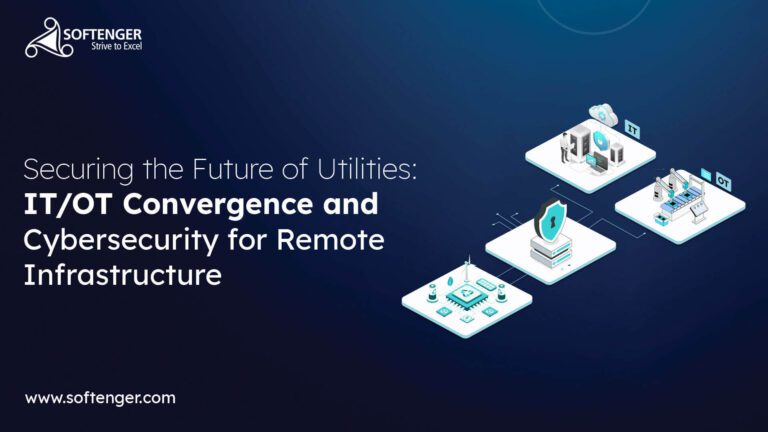
Securing the Future of Utilities: IT/OT Convergence and Cybersecurity for Remote Infrastructure
The security principles from IT/OT convergence in industrial environments apply directly to automotive and aerospace manufacturing — where SCADA systems, PLC networks, and production IT share boundaries that sophisticated attackers and TISAX auditors both examine closely.
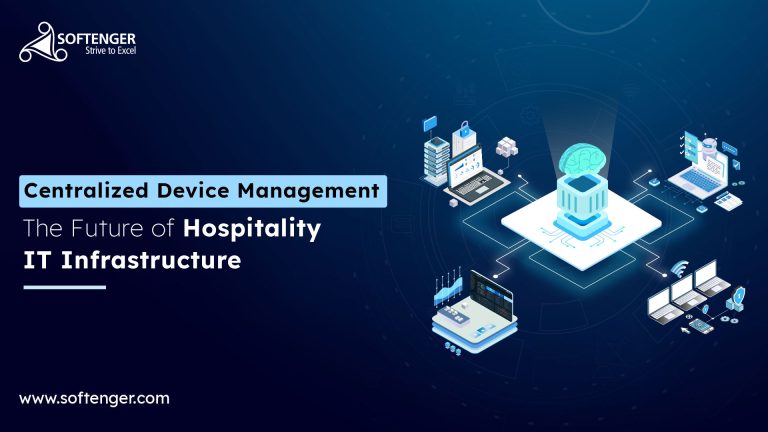
Why Remote and Centralized Device Management Is Transforming IT Operations Across Distributed Infrastructure
The centralized remote management model transforming multi-site operations applies directly to automotive and aerospace enterprises managing production IT, test lab equipment, and engineering workstations across globally distributed manufacturing networks and design centres.
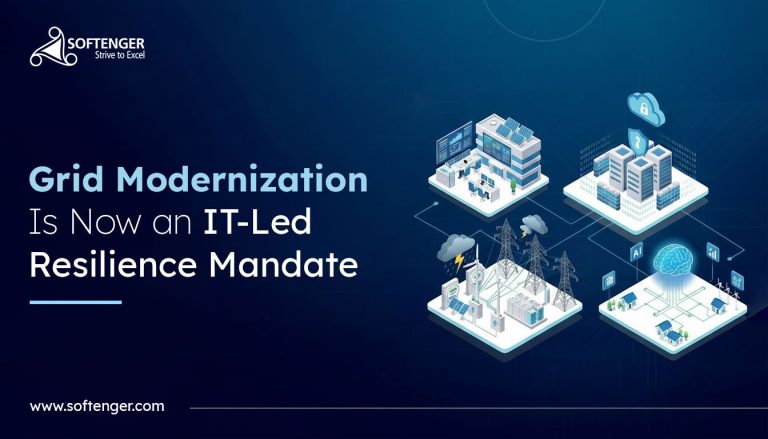
IT-Led Infrastructure Modernization: Building Resilient, Secure Operations at Scale
How enterprises managing complex distributed infrastructure — including automotive manufacturers modernizing from legacy SCADA and on-premises ERP to cloud-connected production and design platforms — use managed IT frameworks to drive transformation without disrupting live operations.
Questions UAE IT leaders ask before engaging Softenger
Tell us about your UAE IT environment. We’ll show you what Gulf-calibrated managed looks like.
A conversation with a Softenger UAE IT specialist produces a documented multi-jurisdiction topology and compliance assessment — not a generic proposal. We review your IT estate, regulatory obligations per entity, and cloud data residency position, then produce specific recommendations. No commitment required.
🇦🇪 Request a UAE Enterprise IT Assessment
ISO 27001 certified. Handled securely, never shared with third parties.