

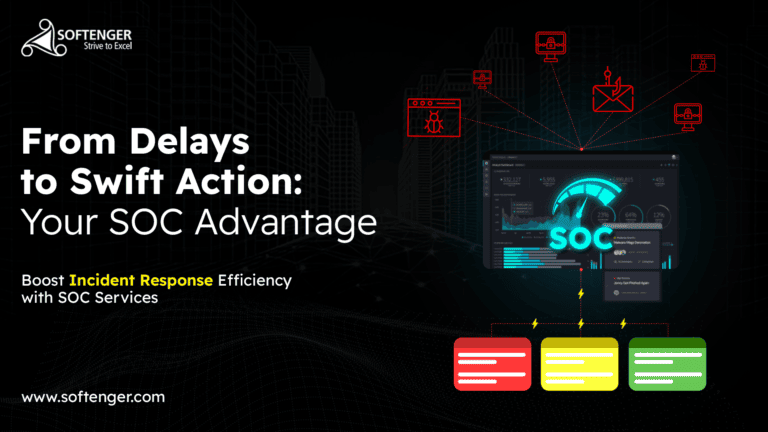
Quick Incident Response with Managed SOC Services
In today’s fast-paced digital landscape, the speed at which an organization detects and responds to cyber threats can mean the difference between a minor incident and a major breach. This is why efficient incident response is critical for modern businesses.
Cyber attack incidents can escalate rapidly, resulting in significant downtime, financial losses, and reputational damage. In this article, we examine the importance of rapid incident response, the challenges with traditional methods, and how advanced managed SOC solutions can significantly improve your incident response capabilities — including key performance metrics and a real-world case study that illustrates the benefits of streamlined SOC monitoring and proactive incident management.
- Why speed is the defining factor in modern incident response
- The business impact of slow breach detection and containment
- Four structural challenges that cripple traditional SOC methods
- How managed SOC services transform incident response capability
- KPIs that measure SOC efficiency — and what good looks like
- Real-world case study: mid-sized financial institution IR transformation
- Best practices for optimizing your incident response process
Why Fast Incident Response Changes Everything
When it comes to cybersecurity, every second counts. The longer a threat remains undetected or unaddressed, the greater the opportunity for cyber attackers to infiltrate deeper into your systems. Rapid incident response is essential because it:
Rapid incident response reduces damage by limiting breach scope, minimizes downtime by resolving incidents faster, enhances trust among customers and stakeholders, and mitigates risk by neutralizing threats before they propagate. In a world where cyber threats evolve continuously, a delay of even a few minutes can be critical.
A slow incident response triggers cascading consequences. If malware spreads unchecked, it may compromise critical business data and disrupt operations. Prolonged breaches often lead to regulatory penalties, increased cybersecurity insurance premiums, and lasting reputational damage. Ensuring rapid, coordinated response is not just a technology decision — it is a strategic business imperative.
Every minute of undetected lateral movement is a minute attackers use to entrench themselves deeper in your environment. Speed is not a performance metric — it is a containment strategy.
Four Challenges That Break Traditional Incident Response
Most organizations struggling with incident response aren’t facing a technology shortage — they’re facing a structural problem. Traditional methods create four compounding failure points that become more severe as threat volume increases:
Traditional security operations rely on a patchwork of tools and manual processes. Alerts from firewalls, intrusion detection systems, and antivirus software remain siloed. Without proper integration, correlating events, prioritizing incidents, and acting swiftly becomes structurally impossible — even with a capable team.
In many organizations, incident response relies heavily on manual processes. Analysts must sift through countless alerts — many of which are false positives — before identifying a genuine threat. This manual triage not only delays response times but increases the likelihood of human error. When security teams are overloaded, critical alerts may be missed or delayed, giving attackers more time to exploit vulnerabilities.
Many companies — especially small to mid-sized organizations — lack the dedicated resources to maintain a 24×7 in-house SOC. Limited budgets, shortage of skilled personnel, and competing business priorities lead to under-resourced security operations. As a result, even when a breach is detected, the response may be delayed due to insufficient staffing or expertise.
Traditional incident response involves multiple sequential stages — initial detection, investigation, containment, eradication, and recovery. Coordinating these steps manually, without streamlined processes and automation, can prolong response times and increase the overall impact of a breach. Each stage introduces decision latency that compounds the total exposure window.
How SOC Solutions Transform Incident Response
Managed SOC services offer a powerful structural alternative to traditional incident response methods. By outsourcing to specialized providers, organizations leverage advanced technologies and expert teams to directly address each failure point above.
A unified SOC monitoring platform aggregates data from various security sources, providing a comprehensive view of the threat landscape. This centralization allows for faster detection and more accurate incident correlation — replacing siloed alerts with a single, actionable intelligence feed.
Advanced tools incorporate automation into the incident management process — swiftly filtering false positives and prioritizing genuine threats. Automation reduces reliance on manual analysis and accelerates the entire response workflow. Key implementations include:
- Automated alert filtering to reduce noise and analyst burnout
- AI-driven correlation tools to connect disparate data points and identify threat patterns
- Automated workflows for standard incident response procedures
Managed service providers bring dedicated cybersecurity experts who continuously monitor systems, interpret complex data, and make informed decisions rapidly. This expert oversight ensures that incidents are addressed promptly and effectively — not by generalists juggling competing priorities, but by specialists with a single focus.
Managed SOC services scale with your organization’s needs. As your business grows, the SOC adapts to increased data volumes and evolving threat vectors without requiring proportional increases in internal headcount or capital investment in new tooling.
Beyond reactive response, modern SOC solutions emphasize proactive incident management. Continuously updated threat intelligence feeds enable the SOC to anticipate and prepare for emerging threats, reducing the time needed to identify and respond. Data from past incidents is analyzed to refine response strategies iteratively — continuously narrowing the window between detection and containment.
KPIs That Measure SOC Incident Response Efficiency
When evaluating the effectiveness of SOC solutions in improving incident response, five key performance indicators define whether a SOC is genuinely performing — or simply adding process without progress. Here is what each metric tracks, and what a well-optimized managed SOC achieves:
| KPI | Traditional SOC Baseline | Managed SOC Target |
|---|---|---|
| Average Response Time | Hours from alert to action (often 4–8 hrs) | Minutes from detection to escalation |
| False Positive Rate | 60–80% of alerts require manual review | Significantly reduced via AI-driven filtering |
| Incident Containment Time | 4–8 hours from detection to isolation | Under 1 hour with automated playbooks |
| Mean Time to Repair (MTTR) | 8–24+ hours for full system restoration | 2–4 hours with structured recovery workflows |
| Daily Alert Volume | Unfiltered — analysts overwhelmed by noise | AI-prioritized — only genuine threats escalated |
Organizations that implement managed SOC services often see dramatic improvements across all five metrics. Many companies report response time reductions of nearly 50% compared to traditional methods, alongside marked decreases in false positives and faster incident containment. These improvements translate directly into cost savings and a stronger overall security posture.
24×7 Incident Response in Action: A Financial Institution Transformed
The benefits of managed SOC services are best illustrated through a real-world deployment — one that demonstrates what structural improvement, not incremental adjustment, actually looks like.
Mid-Sized Financial Institution — From Fragmented to Fortified
This example underscores the transformative impact of managed SOC services. The gains are not incremental — they are structural. When monitoring is continuous, correlation is automated, and expertise is dedicated, incident response changes from a reactive function into a genuine operational capability.
Best Practices for Optimizing Incident Response
Whether building toward a managed SOC engagement or strengthening existing capabilities, four practices consistently drive measurable improvement in incident response efficiency:
-
01Embrace Automation Implement automated alert filtering to reduce noise. Utilize AI-driven correlation tools to connect disparate data points and identify patterns. Set up automated workflows for standard incident response procedures — freeing human analysts to focus on critical decision-making and strategic response, not routine triage.
-
02Centralize Security Operations Use platforms that aggregate data from firewalls, IDS, endpoint protection, and cloud environments. Ensure real-time data visualization through comprehensive dashboards. Maintain continuous communication between automated systems and human analysts. A centralized SOC monitoring platform is prerequisite to a fast one — you cannot correlate what you cannot see.
-
03Invest in Continuous Training Technology evolves rapidly, and so do cyber threats. Provide regular training sessions on the latest cybersecurity trends. Encourage participation in industry conferences and workshops. Develop internal knowledge-sharing programs to spread expertise across the team — currency of knowledge is a direct determinant of response quality.
-
04Regularly Review and Update Incident Response Plans An effective incident management process is not static — it requires constant review and updates to remain effective against emerging threats. Conduct periodic audits of SOC processes. Update response protocols based on post-incident reviews. Leverage lessons learned from past incidents to continuously refine future response strategies.
Cybersecurity Expertise Built for Organizations That Can’t Afford to Wait
At Softenger, we deliver robust cybersecurity solutions with the right resources, tools, and expertise available 24×7. Since our inception in August 1999, we have built a reputation for excellence through ISO 27001:2022 and ISO 9001:2015 certifications and adherence to RBA standards. With operations in India, Singapore, and Malaysia, we offer cost-optimized solutions — both on-premise and remote — across IT Infrastructure Management, Cybersecurity, Datacentre Management, and IT Process Automation.
-
24×7 Managed SOC Monitoring Continuous threat detection and incident response across IT infrastructure, endpoints, and cloud environments — with dedicated analysts, not automated dashboards alone.
-
AI-Driven Alert Correlation Automated filtering and prioritization that eliminates false positive noise — ensuring genuine threats reach the right analyst at the right time, every time.
-
Incident Response Playbooks Structured, tested response workflows that eliminate improvisation during an active incident — reducing containment time and limiting blast radius across all threat categories.
-
Banking and Telecom Sector Recognition Our commitment to integrity, service excellence, and rapid response has earned recognition in banking and telecom — sectors where delayed incident response carries direct regulatory and financial consequence.
SOC & Incident Response — Questions We’re Asked Most
-
An incident response SOC (Security Operations Center) is a dedicated team and technology platform responsible for detecting, analyzing, and responding to cybersecurity incidents in real time. Managed SOC providers operate 24×7, combining automated detection tools with expert analysts to minimize response times and limit breach impact across your entire environment.
-
Managed SOC services improve response times through centralized monitoring that aggregates data from all security tools, AI-driven automation that filters false positives and prioritizes real threats, and dedicated expert teams available around the clock. Organizations switching from traditional methods typically report response time reductions of up to 50% within months of deployment.
-
Five KPIs define SOC IR efficiency: Average Response Time (alert to resolution), False Positive Rate (percentage of non-genuine alerts), Incident Containment Time (detection to isolation), Mean Time to Repair (MTTR), and daily Alert Volume. Optimized managed SOCs show measurable improvement across all five within months of deployment.
-
Incident containment time measures how quickly a threat is stopped from spreading — from detection to isolation. MTTR (Mean Time to Repair) measures the full recovery duration, including eradication and system restoration. Containment is a subset of MTTR. Both are tracked separately because containment directly limits blast radius, while MTTR reflects total operational impact and recovery cost.
-
Automation in SOC monitoring uses AI-driven correlation to cross-reference alerts against threat intelligence feeds, behavioral baselines, and contextual data before escalating to human analysts. This filtering significantly reduces the volume of alerts requiring manual review, allowing analysts to focus on genuine threats rather than noise — and meaningfully shortening average response times across the board.
Ready to Boost Your Incident Response Efficiency and Protect Your Organization from Cyber Threats?
Softenger’s 24×7 managed SOC combines expert analysts, AI-driven automation, and proven incident response playbooks to dramatically cut your response times — and your exposure.