
Cost Optimization in U.S. Manufacturing 2026: Smart Tech & ROI
A Make-or-Break Moment for U.S. Manufacturing Competitiveness
2026 is a pivotal year for U.S. manufacturers navigating rising production costs, persistent labor shortages, and ongoing supply chain disruptions compounded by tariff uncertainty. Forward-looking leaders are turning to smart technologies — from IIoT and predictive maintenance to digital twins and FinOps-driven cloud management — to achieve measurable savings.
This article explores practical strategies that cut operating costs, strengthen resilience, and deliver ROI in months, not years. The emphasis throughout is on proven plays, not speculative pilots — technologies with documented returns that CIOs can present with confidence to plant leadership and CapEx committees.
- Why 2026 demands a new approach — the converging cost pressures U.S. manufacturers face
- Smart tech that pays back: IIoT, predictive maintenance, and digital twins with 2026 AI updates
- Cloud FinOps for manufacturing — turning cloud sprawl into cost visibility and accountability
- Building operational resilience — supplier diversity, remote monitoring, and real-time visibility
- The 6-step ROI playbook — a practical roadmap from audit to continuous monitoring
- Mini case studies: automotive predictive maintenance and Softenger-led FinOps savings
- Next steps for manufacturing leaders ready to act now
Why 2026 Demands a New Approach to Manufacturing Cost Optimization
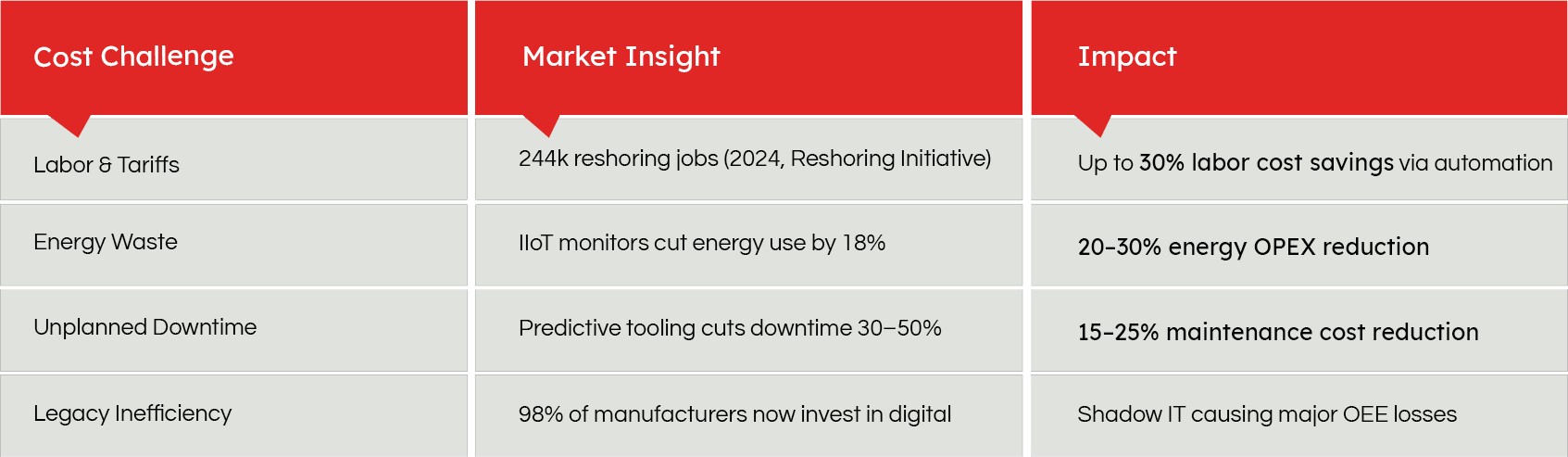
U.S. manufacturers face a convergence of cost pressures in 2026 that traditional lean methods cannot fully address. Digital-first cost optimization is no longer a strategic option — it is the baseline requirement for staying competitive in domestic production.
CIOs and plant managers cannot rely solely on traditional lean methods. Digital-first cost optimization is required to stay competitive — and 2026’s converging pressures have compressed the timeline for action.
Smart Tech That Actually Delivers ROI: IIoT, Predictive Maintenance & Digital Twins
Three technologies now have well-established ROI track records in U.S. manufacturing environments. Each is delivering measurable returns — and each has been materially upgraded in 2026 by AI and GenAI integration that is accelerating deployment timelines and expanding savings ranges.
Industrial IoT sensors and connected dashboards allow manufacturers to track equipment health, energy use, and line efficiency in real time. Deloitte research confirms IIoT adoption reduces downtime and energy costs by 10–30% depending on implementation scope.
Unplanned downtime costs U.S. manufacturers an average of $260,000 per hour. Predictive analytics extend asset life, reduce failures, and optimize maintenance schedules. Most adopters achieve ROI within 12–24 months through avoided outages and reduced spare parts spend.
By mirroring assets virtually, manufacturers can simulate production changes, test prototypes, and redesign layouts without disrupting live operations. Gartner predicts digital twins reduce time-to-market by up to 30% in advanced manufacturing contexts.
Cloud FinOps for Manufacturing: From Cost Sprawl to Cost Visibility
Cloud adoption is accelerating across U.S. plants for analytics, IoT platforms, and ERP systems. Without governance, cloud costs spiral. FinOps for manufacturing aligns finance and engineering teams to maximize ROI — creating shared accountability for cloud spend rather than treating it as uncategorized IT overhead.
Building Resilience in Manufacturing Operations: Beyond Cost Reduction
Cost optimization is not just about savings — it is also about building the operational resilience that protects those savings when disruptions occur. Softenger enables resilience with remote infrastructure monitoring, ensuring uptime and continuous production across distributed manufacturing environments.
The Practical ROI Playbook for U.S. Manufacturing CIOs
A step-by-step roadmap ensures measurable outcomes — converting technology investment from a capital risk into a documented ROI narrative that leadership can track and CapEx committees can approve. This six-step sequence applies across IIoT, FinOps, and predictive maintenance deployments.
ROI in Action: Documented Outcomes from Real Deployments
These two examples represent the type of measurable outcomes manufacturing CIOs should expect from well-executed IIoT and FinOps deployments — not aspirational projections, but documented results from production environments.
A U.S. auto-parts manufacturer deployed AI-powered predictive maintenance across its highest-downtime production lines. Vibration and temperature sensors fed anomaly detection models that issued maintenance tickets before failures occurred.
Within the first 12 months, unplanned downtime was measurably reduced — delivering cost avoidance across avoided repairs, emergency labor, and lost production time.
A U.S. manufacturing client engaged Softenger to implement a cloud FinOps program across its analytics, ERP, and IIoT platform workloads. Rightsizing, reserved instance optimization, and cost accountability frameworks were deployed across the cloud estate.
The program delivered measurable cloud infrastructure savings within 90 days while simultaneously improving performance reporting visibility for plant and finance leadership.
Cost Optimization Is Not Optional in 2026 — It Is the Foundation for Competitiveness
By adopting IIoT, predictive maintenance, digital twins, and FinOps, U.S. manufacturing leaders can deliver ROI while safeguarding operational resilience. The technology is proven. The ROI timelines are documented. The question is sequencing — which lever to pull first for your specific cost profile.
Frequently Asked Questions on U.S. Manufacturing Cost Optimization
-
FinOps is a cloud financial management framework that helps manufacturers control IT spending. It combines governance, cost optimization, and performance tracking to ensure cloud investments deliver measurable ROI — with finance and engineering aligned on accountability for every dollar of cloud spend. In 2026, FinOps is increasingly applied to IIoT platform costs as well as traditional ERP and analytics workloads.
-
IIoT pilots typically reduce downtime and energy consumption by 10–30%. Savings depend on deployment scale, industry, and the maturity of predictive analytics applied to production data. In 2026, AI-augmented IIoT platforms are pushing the upper range of savings to 35% for mature deployments — with edge AI reducing the latency and connectivity constraints that limited earlier implementations.
-
Most U.S. manufacturers achieve ROI from predictive maintenance within 12–24 months. Gains come from avoiding downtime, extending asset life, and reducing emergency repair costs. In 2026, GenAI-assisted alert triage and automated work order generation are compressing this timeline to 9–18 months for deployments that don’t require specialist data science teams to interpret sensor anomalies.
-
Softenger helps manufacturers with cloud cost management, remote IT monitoring, and application support. These services reduce IT overhead, improve resilience, and accelerate ROI — backed by 24/7 NOC/SOC coverage, ERP/MES integration expertise, and post-deployment ROI tracking dashboards. One U.S. Softenger client reduced cloud infrastructure spend by 22% within 90 days through a structured FinOps engagement.
Cost optimization in 2026 is not optional — it is the foundation for competitiveness
Softenger helps U.S. manufacturers cut cloud costs, reduce downtime, and deploy IIoT with 24/7 NOC/SOC support. Get a free remote infrastructure audit and see measurable results within 90 days.