
AI in Hospitality: Why Infrastructure Modernization Is the True Engine of Hotel Innovation
The AI Revolution in Hospitality Is Already Here
From AI-powered chatbots welcoming guests to predictive analytics preventing maintenance issues before they occur, artificial intelligence is redefining modern hospitality. Leading hotel chains across North America are investing heavily in AI to boost efficiency, enhance satisfaction, and optimize revenue.
Yet amid this transformation, one truth stands out: AI’s success depends entirely on the strength of its infrastructure. Without secure, connected, and scalable backend systems, even the most sophisticated AI engines can’t deliver real-time insights or seamless guest journeys.
- Why legacy infrastructure is the #1 barrier to AI adoption — and what 61% of hotel CIOs say
- The Hospitality Infrastructure Readiness Framework — four maturity levels mapped
- What modern, AI-ready infrastructure actually looks like across four dimensions
- API orchestration — the nervous system connecting PMS, CRM, IoT, and analytics
- Where AI delivers measurable ROI: maintenance, forecasting, pricing, and automation
- Why Remote IT Infrastructure Management (RIM) is becoming the operational backbone
- Softenger’s AOTS framework — from assessment to continuous support
- Real-world lessons from Wyndham, IHG, and Marriott
Legacy Infrastructure Holding Back Innovation
Many hotels still run on outdated property management systems (PMS), fragmented databases, and on-premises servers that struggle with data-intensive workloads. These environments can’t handle the real-time, high-velocity data flow that AI requires.
When systems remain disconnected, hotels face inconsistent guest data across locations, manual coordination between booking, housekeeping, and billing, limited ability to personalize at scale, and slow rollout of new digital services.
The Hospitality Infrastructure Readiness Framework
To help IT leaders benchmark progress, Softenger proposes the Hospitality Infrastructure Readiness Framework — a four-level maturity model that maps the journey from legacy to AI-ready operations. Most hotel groups today operate between Levels 2 and 3, with Level 4 defining the North Star for AI-powered hospitality.
-
Level1Fragmented FoundationsDisconnected systems, manual workflows, and reactive maintenance dominate. PMS, CRM, and billing operate in isolation. AI cannot be deployed at this stage — data is neither unified nor reliable enough.
-
Level2Connected CorePartial integrations between PMS, CRM, and RMS. Automation is emerging but not real time. Some data consolidation exists, but latency and inconsistency remain barriers to AI-driven decision-making.
-
Level3Intelligent InfrastructureA hybrid, API-driven environment enables predictive maintenance, dynamic pricing, and AI-driven recommendations. Data flows are near-real-time. Most forward-leaning hotel groups are working toward or at this level.
-
Level4AI-Ready Enterprise — The North StarCloud-first, compliant, and observability-enabled infrastructure ensures 99.99% uptime, predictive alerts, and seamless AI deployment across all properties. This is the target operating model for 2026 and beyond.
Modern Infrastructure: The Foundation for AI-Powered Hospitality
To unlock AI’s full value, hotels need cloud-first, API-enabled, remotely managed infrastructure. This modern backbone ensures four critical capabilities that legacy environments structurally cannot provide:
API Orchestration: The Digital Backbone of Smart Hospitality
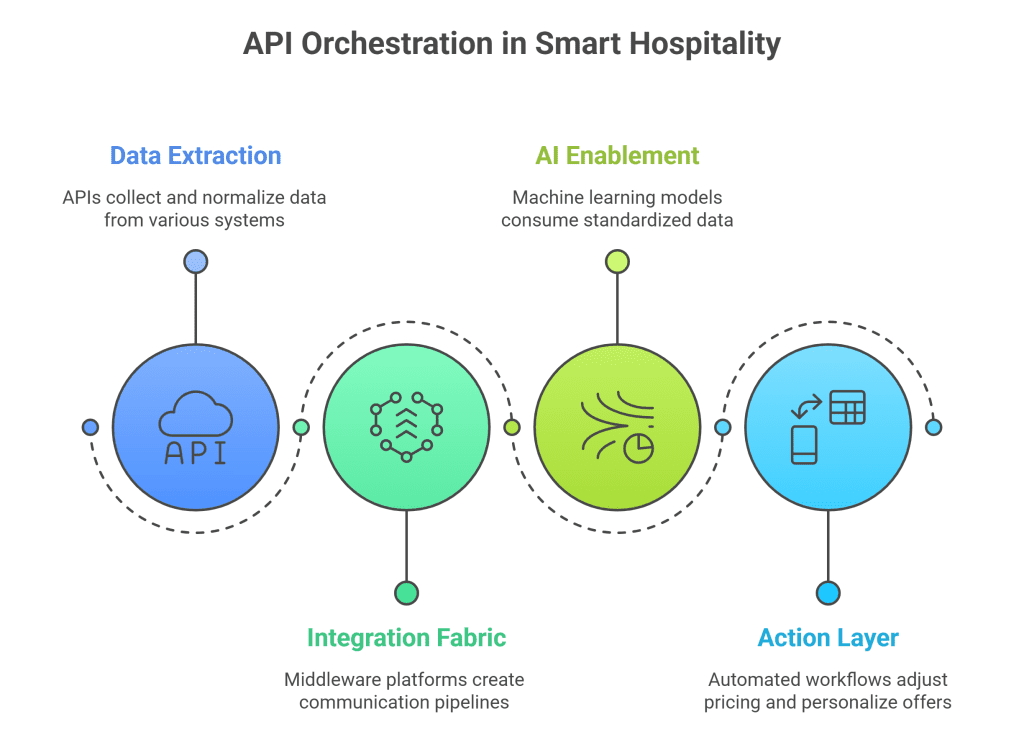
API orchestration forms the digital backbone of modern hospitality ecosystems, connecting PMS, CRM, IoT, and analytics layers for unified data intelligence.
-
Data ExtractionCollect and Normalize Multi-System Data APIs pull structured and unstructured data from every hotel system — PMS check-in records, IoT sensor readings, CRM guest profiles — and normalize it into a single, query-ready data layer.
-
Integration FabricEvent-Driven Pipelines at <100ms Latency Middleware platforms create event-driven communication pipelines with latency under 100ms — ensuring AI models always act on current data, not stale snapshots from hours ago.
-
AI EnablementStandardized Data Fuels Machine Learning Machine learning models consume standardized data to deliver actionable insights — from demand forecasting to guest sentiment scoring — without custom data-cleaning pipelines slowing every deployment.
-
Action LayerAutomated Workflows Close the Loop Automated workflows adjust room pricing, trigger maintenance tickets, or personalize guest offers in real time — turning AI insights into operational actions without manual handoff.
From Forecasting to Personalization: Where AI Delivers ROI
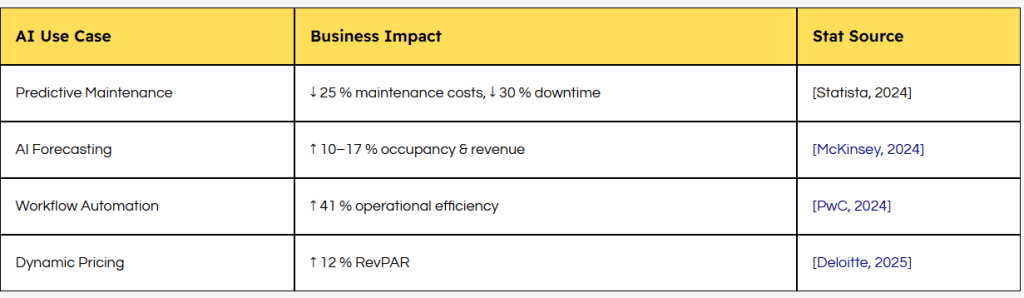
AI adoption continues to demonstrate measurable ROI across hospitality operations. These gains depend on infrastructure intelligence — secure data pipelines, observability, and predictive IT management. Without the right foundation, none of these outcomes are achievable at scale.
| AI Use Case | Business Impact | Source |
|---|---|---|
| Predictive Maintenance | ↓ 25% maintenance costs · ↓ 30% downtime | Statista, 2024 |
| AI Forecasting | ↑ 10–17% occupancy & revenue | McKinsey, 2024 |
| Workflow Automation | ↑ 41% operational efficiency | PwC, 2024 |
| Dynamic Pricing | ↑ 12% RevPAR | Deloitte, 2025 |
Why Remote IT Infrastructure Management Matters at Scale
As hotel portfolios expand globally, the complexity of managing hybrid cloud environments grows exponentially. Remote IT Infrastructure Management (RIM) provides centralized control and SLA-backed reliability for continuous operations — transforming from a maintenance function into the backbone that powers AI scalability.
RIM has evolved from maintenance to become the operational backbone that powers predictive maintenance, compliance, and continuous guest-experience innovation.
The AOTS Framework: Enabling AI-Ready Infrastructure
For over 25 years, Softenger has empowered enterprises to modernize and manage IT ecosystems through its AOTS (Advise, Optimize, Transform, Support) model. Applied to hospitality, it maps a deliberate path from legacy to AI-ready — with measurable outcomes at every stage.
-
AAdvise — Infrastructure Maturity & AI Readiness Assessment
Assess current infrastructure maturity, identify integration gaps, and benchmark AI readiness against the four-level Readiness Framework. Clarity before commitment.
-
OOptimize — Re-architect Legacy for Hybrid Scalability
Re-architect legacy PMS and on-premises systems for hybrid scalability and data integration — eliminating silos without disrupting live operations during the transition.
-
TTransform — Automate IT Workflows with Observability & CSPM
Automate IT workflows, monitoring, and orchestration with observability and Cloud Security Posture Management layers — building the infrastructure that AI models actually require.
-
SSupport — Continuous RIM with SLA-Driven Assurance
Deliver continuous Remote Infrastructure Management with SLA-driven assurance, telemetry, and predictive alerting — sustaining uptime, speed, and operational intelligence at scale.
Softenger’s approach helps hospitality enterprises evolve confidently toward AI-driven excellence with measurable gains in uptime, speed, and operational intelligence.
AI Infrastructure Readiness Checklist
Benchmark your current infrastructure against the four-level Readiness Framework. Identify gaps, prioritize investments, and build a clear path toward AI-ready hotel operations.
Download the Checklist →
Real-World Lessons: From Disconnected Systems to AI-Driven Excellence
North American and global hospitality leaders — Wyndham, IHG, and Marriott — prove that AI transformation begins with infrastructure modernization, not AI tooling. Their initiatives delivered outcomes that define the new operating standard for digital-first hospitality.
CIO Priorities for the AI-Ready Hospitality Future
The next wave of AI — autonomous operations, generative guest services, and real-time revenue optimization — will demand secure, responsive, and observability-driven infrastructure. CIOs who modernize today will be best positioned to compete.
-
01Integrate AI Platforms Without Friction Cloud-first, API-driven infrastructure means new AI models can plug in without per-property custom development. Integration velocity becomes a competitive advantage.
-
02Protect Sensitive Data Through Encryption, IAM, and CSPM Guest data is subject to GDPR, PCI-DSS, and evolving local regulations. Security posture management must be continuous — not point-in-time assessments at audit intervals.
-
03Scale Globally While Maintaining Uptime and Compliance Multi-property operations across jurisdictions require centralized governance with local adaptability. Hybrid infrastructure with observability baked in is the only architecture that scales without trade-offs.
-
04Achieve Measurable Improvements in Latency, Efficiency, and ROI Infrastructure modernization should produce traceable outcomes — latency reduction percentages, uptime SLAs, maintenance cost deltas. If it can’t be measured, it can’t be defended to the board.
Hotels investing in hybrid, API-driven systems today are accelerating AI adoption, reducing latency, and future-proofing operations at scale.
Building AI-Ready Infrastructure for Hospitality Enterprises
Softenger brings 25+ years of enterprise IT management to hospitality — applying the AOTS framework through ISO 27001:2022 certified operations, 24×7 Remote Infrastructure Management, and AI-enriched observability. We operate across India, Singapore, and Malaysia, delivering cost-optimized solutions both on-premise and remote.
-
Hospitality Infrastructure Assessment Benchmark your current maturity level, identify integration gaps, and map the fastest path to AI-ready operations using the Readiness Framework.
-
API Orchestration & Systems Integration Connect PMS, CRM, RMS, and IoT systems into a unified, API-driven data fabric — eliminating silos and enabling AI to act on live, complete data.
-
24×7 Remote Infrastructure Management SLA-backed, observability-driven RIM with self-healing automation — delivering 99.99% uptime targets and RTO under 15 minutes across multi-property environments.
-
CSPM & Compliance-Ready Security Continuous Cloud Security Posture Management with encryption and IAM governance — protecting guest data against GDPR and PCI-DSS requirements without slowing AI deployment velocity.
AI-Ready Hospitality Infrastructure — Frequently Asked Questions
-
AI systems rely on fast, secure, and integrated data environments. Legacy PMS or on-prem servers can’t process real-time analytics or IoT data efficiently. Modern, cloud-first infrastructure delivers scalable compute, API-based integration, and observability enabling AI to predict demand, personalize guest experiences, and optimize operations with minimal latency.
-
Red flags include fragmented PMS and CRM systems, manual data reconciliation, inconsistent guest profiles, and frequent downtime. If AI pilots stall or new apps require custom code, orchestration and scalability are lacking. Hotels at Level 1–2 in the Readiness Framework typically face these issues. → Download the Checklist to assess your AI readiness.
-
API orchestration is the digital nervous system connecting PMS, CRM, RMS, and IoT systems. It standardizes data flow, keeping latency below 100ms and eliminating silos. This enables AI to act on live data — powering predictive maintenance, dynamic pricing, and hyper-personalized guest experiences across all properties.
-
RIM delivers centralized, SLA-driven oversight of multi-property environments. With 24×7 monitoring, self-healing automation, and observability, it ensures 99.99% uptime and compliance with GDPR and PCI-DSS. RIM transforms infrastructure into a predictive, continuously optimized operation supporting AI scalability.
-
Start with an Infrastructure Readiness Assessment to identify bottlenecks, integration gaps, and security risks. Move toward hybrid, API-driven architecture with observability and CSPM layers. Partner with modernization experts like Softenger who deliver SLA-based RIM and transformation frameworks ensuring measurable ROI and faster AI deployment.
-
AI-ready infrastructure can deliver 25–40% efficiency gains, 30% downtime reduction, and 10–17% higher occupancy through predictive analytics and automation — based on published data from Deloitte, PwC, and McKinsey. These are not projections; they are documented outcomes from hotel chains that completed infrastructure modernization before deploying AI.
Building Resilient, AI-Ready Hospitality Systems
As hospitality enters an era of intelligent automation, Remote Infrastructure Management and observability become the twin enablers of resilience. Hotels investing in hybrid, API-driven systems today are accelerating AI adoption, reducing latency, and future-proofing operations at scale.