
Enhancing Security
Operations Efficiency
A global technical services firm’s shared SecOps team was spending too much time on infrastructure engineering — time that should have been on core security product work and protecting customer IT stacks. Softenger took ownership of the infrastructure layer so the security engineers could do security engineering.
SOC Infrastructure Support — Multi-Cloud & Hybrid
When your best security engineers are doing infrastructure work
The client operates a shared Security Operations Center — managing cybersecurity products and protecting IT stacks for multiple customers simultaneously. Their SecOps team was skilled, experienced, and in high demand. But a growing share of their capacity was being absorbed by infrastructure engineering: maintaining integrations, managing product configurations, and keeping the underlying SOC environment operational across a multi-cloud and hybrid deployment.
Infrastructure work isn’t where a security product engineering team creates value. It’s where their capacity disappears. The client needed a way to restore their SecOps team’s focus to the security product work that kept their customers protected and their business competitive — without adding headcount to an already stretched team.
Allow the client to focus on core security product engineering and safeguarding customer IT stacks. Relieve the shared Security Operations team from time-intensive infrastructure engineering tasks. Maintain a competitive edge in multi-customer security operations.
Skilled Engineers Pulled Toward the Wrong Work
Balancing security product engineering with infrastructure management created a constant pull on the team’s most experienced people — the engineers who should have been focused entirely on customer security outcomes.
SecOps Capacity · Resource AllocationComplex Shared SOC with Diverse Product Integrations
A shared SOC serving multiple customers requires constant integration management across different cybersecurity products and toolsets. Keeping that environment operational and current is a specialist task in its own right — separate from the security engineering the team was hired to do.
Shared SOC · Integration ComplexityMulti-Cloud and Hybrid Environment Adds Operational Overhead
A multi-cloud and hybrid deployment means infrastructure management spans multiple platforms, each with different tooling, monitoring, and operational requirements. Without a dedicated infrastructure engineering function, that overhead lands on whoever is available — usually the people the business least wants distracted.
Multi-Cloud · Hybrid Infrastructure · OverheadA clean split — who owns what
The engagement worked because the division of responsibility was unambiguous. Softenger took full ownership of the infrastructure engineering layer. The client’s SecOps team retained full ownership of the security product engineering and customer protection work. No overlap. No ambiguity. No infrastructure work landing back on the wrong desk.
Infrastructure Engineering Layer
Core Security Engineering
Why this split works where other models don’t
Shared responsibility models fail when infrastructure work keeps drifting back to the security team during incidents or product launches. The reason Softenger’s model works is that infrastructure ownership is genuinely transferred — not borrowed back when things get complicated. Softenger’s team absorbs the operational pressure so the client’s team doesn’t have to.
Three parallel tracks —
infrastructure, automation, integration
Softenger’s engagement ran across three simultaneous workstreams. Infrastructure ownership was immediate. Automation was built progressively. Product integration management was ongoing. All three ran in parallel — because the client needed all three to be solved at once.
The automation component — Python and Jenkins — was particularly important. Automating recurring infrastructure tasks didn’t just save Softenger’s team time. It permanently reduced the operational overhead of the SOC environment, making it easier to manage and less likely to generate the kind of manual work that previously fell to the client’s security engineers.
Cybersecurity product integration management — maintaining the operational readiness of the diverse security products the firm used across its shared SOC — required continuous attention. That attention is what Softenger provides. Not a one-time integration and handoff, but sustained operational responsibility.
Infrastructure Engineering Ownership
Softenger assumed full responsibility for all infrastructure engineering tasks within the client’s SecOps team — immediately and completely.
- Full ownership of SOC infrastructure engineering tasks
- Multi-cloud and hybrid environment operational management
- Incident response and resolution at the infrastructure layer
- Capacity and performance management for the SOC environment
- Infrastructure change management and documentation
Automation — Python & Jenkins
Regular development and deployment of automation solutions that reduced manual overhead and improved operational efficiency across the SOC environment.
- Automation scripts developed in Python for recurring infrastructure tasks
- Jenkins pipelines for deployment, testing, and operational workflows
- Reduction of manual touchpoints in SOC infrastructure operations
- Continuous improvement — automation added as new use cases were identified
- Documentation and handover for all automation developed
Cybersecurity Product Integration Management
Ongoing management of the integration and operational readiness of the diverse cybersecurity products used across the client’s shared SOC environment.
- Integration management across diverse cybersecurity product stack
- Operational readiness maintenance for shared SOC tooling
- Product update coordination and testing in the SOC environment
- Cross-product compatibility and configuration management
- Support for new product onboarding into the shared SOC
What changed for the
SecOps team — and why it matters
The outcomes of this engagement aren’t primarily measured in infrastructure metrics. They’re measured in what the client’s security engineers were able to do once infrastructure ownership was no longer their problem.
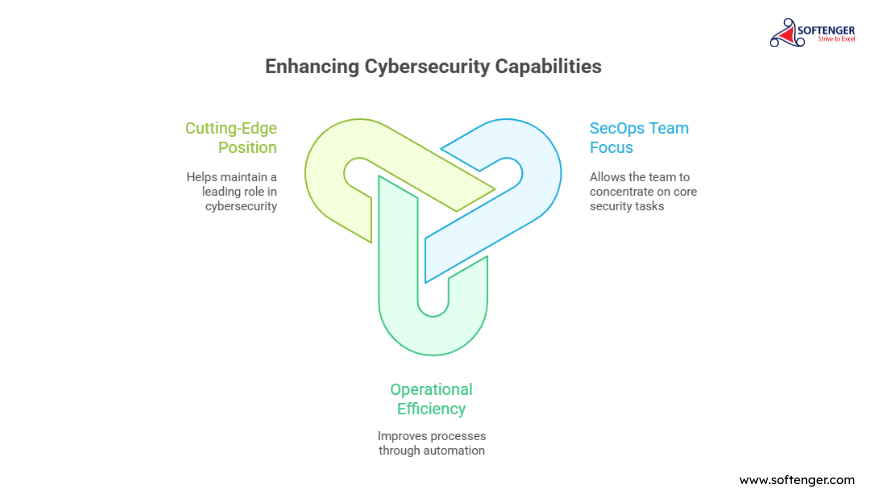
SecOps Team Refocused on Core Security Work
The client’s SecOps engineers returned to core security product implementation and customer IT stack protection — the work they were hired to do and the work that creates value for the firm’s customers.
Operational Efficiency Through Automation
Python and Jenkins automation deployed by Softenger reduced manual overhead in the SOC environment on a continuous basis — improving efficiency not just at point of deployment, but as a permanent structural improvement to how the environment operates.
Competitive Position in Cybersecurity Maintained
With infrastructure engineering off the team’s plate, the client was able to sustain investment in security product development and customer protection — maintaining the cutting-edge position in cybersecurity that defines their business.
Key Takeaway
This project showcases Softenger’s ability to enhance the operational efficiency of Security Operations Centers. By taking over infrastructure engineering and implementing automation, Softenger empowered the client to deliver superior cybersecurity services across a multi-cloud and hybrid environment — without adding headcount to a team that was already performing at capacity.
Python and Jenkins — why this combination matters in a SOC environment
Automation in a SOC infrastructure context isn’t about reducing headcount. It’s about eliminating the category of work that requires a human to be in the loop on a repeating schedule — configuration checks, deployment pipelines, integration health validation, log processing, and operational reporting.
Python’s flexibility makes it the right choice for SOC automation: it has native support for every major cloud API, cybersecurity tool integration, and data manipulation pattern a SecOps environment generates. Jenkins provides the orchestration layer — scheduling, dependency management, and execution visibility across all the automation Softenger developed and deployed.
The result isn’t a single automation deliverable. It’s a continuously growing library of automation that makes the SOC environment progressively easier to manage — and progressively less dependent on manual intervention.
Recurring Tasks Eliminated
Repeating infrastructure tasks that previously required manual intervention are handled automatically — removing them from the operational queue entirely.
Consistent Execution — No Human Variance
Automated pipelines execute the same way every time. Configuration drift, missed steps, and timing errors that come with manual processes are structurally removed.
Faster Integration Readiness
New cybersecurity product onboarding and integration testing is faster when the deployment and validation pipelines are automated — reducing time-to-operational for new tooling in the shared SOC.
Compounding Efficiency Over Time
Each automation deployed reduces the operational burden of the next engagement cycle. The efficiency gains are not one-time — they compound as the automation library grows.
Jenkins — Visibility and Auditability
Jenkins provides execution history, failure logging, and pipeline status visibility across all automation — giving the client’s team a clear view of what’s running and when, without having to manage it themselves.
Every engagement follows
the AOTS framework
This SOC infrastructure engagement was structured around Softenger’s four-phase AOTS model — the same framework applied across every managed services and infrastructure engagement. The Advise phase defined the division of responsibility clearly before any work began. Optimize built the automation layer. Transform handed infrastructure ownership to Softenger. Support kept it running and improving.
The key insight from the Advise phase: the problem wasn’t that the client’s SecOps team was underperforming. It was that they were performing the wrong tasks. Fixing that required an operating model change, not just an infrastructure fix.
Advise
Assessed the client’s SecOps operating model. Identified the infrastructure engineering tasks consuming security team capacity. Defined the division of responsibility before any work began.
Clear ownership model established. Softenger scope defined. Client team’s refocus plan agreed and communicated.
Optimize
Developed and deployed initial automation using Python and Jenkins. Identified the highest-impact recurring tasks and eliminated them from the manual operational queue first.
First automation wave deployed. Jenkins pipelines operational. Manual overhead reduction measurable from day one.
Transform
Full infrastructure engineering ownership transferred to Softenger. Cybersecurity product integration management assumed. Client SecOps team fully refocused on core security work.
Complete infrastructure ownership handover. SOC environment stable under Softenger management. Client team operating at security engineering capacity.
Support
Ongoing infrastructure operations, continuous automation development, and sustained cybersecurity product integration management — keeping the SOC environment current and efficient.
Continued automation library growth. Integration management ongoing. Infrastructure engineering burden permanently removed from client team.
The AOTS model is applied to every Softenger engagement
Whether the work is SOC infrastructure support, IT infrastructure management, application services, or cloud delivery — the four phases of Advise, Optimize, Transform, and Support structure every engagement. The work changes. The discipline doesn’t.
Questions about SOC infrastructure support
-
Softenger assumed responsibility for all infrastructure engineering tasks within the client’s SecOps team — including automation development using Python and Jenkins, integration management of cybersecurity products, and the operational readiness work required to keep the shared SOC environment running across a multi-cloud and hybrid environment.
-
Efficiency improvements came through two parallel tracks: first, by removing infrastructure engineering burden from the client’s skilled security engineers, allowing them to focus on core security product implementation. Second, by systematically developing and deploying automation solutions using Python and Jenkins that reduced manual operational overhead within the SOC environment on a continuous basis.
-
A shared SOC environment manages security operations for multiple customers simultaneously — each with different security tooling, integrations, and compliance requirements. Managing the infrastructure layer of a shared SOC requires constant integration work, product updates, and configuration management across diverse cybersecurity platforms. When that work falls to the same team responsible for customer security product engineering, it competes directly with the work that creates business value.
Tell us what’s pulling
your security team
away from security.
If your skilled security engineers are spending time on infrastructure management, integration maintenance, or automation work they shouldn’t own — Softenger can take that off their plate. The same model we applied here can be scoped to your SOC environment. A conversation with one of our security operations specialists starts with understanding your team’s current split, not with a product pitch.
🛡️ Discuss a Security Operations Challenge
ISO 27001 certified. Your information is handled securely and never shared.