
Manufacturing Cost Optimisation in Singapore — 2026 Tactics for CIOs
Practical IT Tactics That Lower TCO and Reduce Unplanned Downtime
Singapore manufacturers face rising unit costs and supply-chain pressure in 2025. This briefing outlines practical IT tactics — remote-managed IIoT, AIOps, rightsized cloud, and secure hybrid infrastructure — that lower TCO, reduce unplanned downtime, and deliver measurable ROI.
Use the ROI model and downloadable checklist to prioritise investments for production and precision engineering leaders in Singapore.
- Why 2026 is a pivot year for Singapore manufacturers — policy, precision industries, and 5G maturation
- Four IT levers for near-term cost reduction with measurable ROI
- Worked ROI model — CapEx vs OpEx savings for a SGD 2M factory
- Security and resilience checklist for IIoT and hybrid infrastructure
- Singapore grants and incentives — EDG and PSG that lower deployment cost
- Case study evidence from Seagate and IMDA trials
Why 2026 Is Different for Singapore Manufacturing
High-Impact Levers CIOs Can Prioritise for Near-Term Savings
Below are four high-impact levers for near-term cost reduction and measurable value — each with published evidence of typical savings ranges.
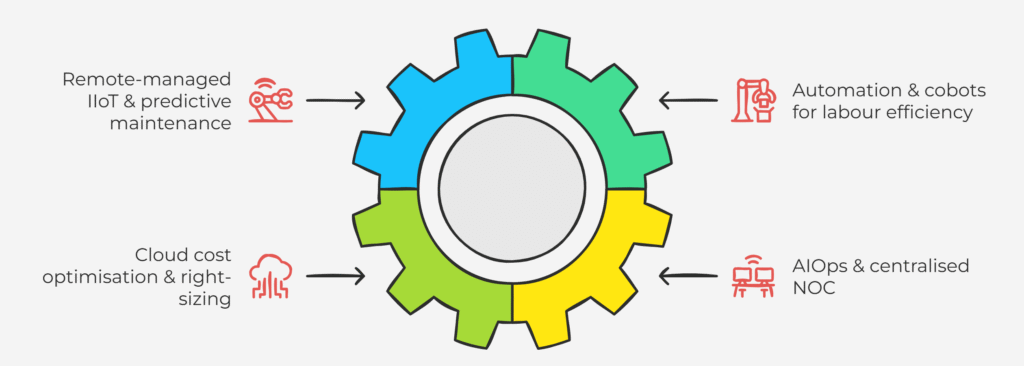
Instrumenting critical equipment with sensors and remotely managing telemetry reduces unplanned downtime and enables condition-based maintenance. Recent sector analyses show predictive maintenance programs commonly deliver mid-teens reductions in maintenance costs, with mature programs reporting 18–25% maintenance/energy savings and up to 50% downtime reductions.
Use remote management + edge analytics for immediate fault detection and push complex model training to centralised cloud or GPU resources.
Collaborative robots (cobots) augment human operators on repetitive tasks — assembly, packaging, inspection — improving throughput and consistency while reducing injury risk and overtime. For Singapore facilities facing tight labour markets, cobots shorten training time and provide predictable labour cost per unit.
Pair cobots with AI vision for closed-loop quality checks to reduce rework and scrap — a repeatable cost lever for precision engineering lines. IMDA’s 5G and Industry 4.0 trials show networked automation use cases are increasingly production-ready.
Cloud migration without governance often increases spend. Rightsizing workloads, applying reserved instances or savings plans, and scheduling non-production workloads can unlock substantial savings. Conservative programme targets for rightsizing and reservations commonly yield 20–30% first-year savings when combined with governance automation.
Track cloud unit economics per production line to make ownership clear and sustain savings beyond the initial implementation cycle. See: Singapore Cloud Cost Optimization.
A centralised NOC with AIOps tooling reduces Mean Time to Detect/Resolve (MTTR) by automating anomaly detection, triage, and remediation playbooks. For multi-site manufacturers, a single pane of glass for uptime, device inventory, and SLA monitoring reduces duplicated operational labour and improves capacity planning.
Embed runbooks for common IIoT device classes to move repeatable fixes from engineers to automated actions — freeing technical staff for higher-value work. Internal visibility also supports accurate SLA reporting for customers and compliance audits.
CapEx vs OpEx Savings — Worked Example
What a 20% Efficiency Improvement Looks Like in Practice
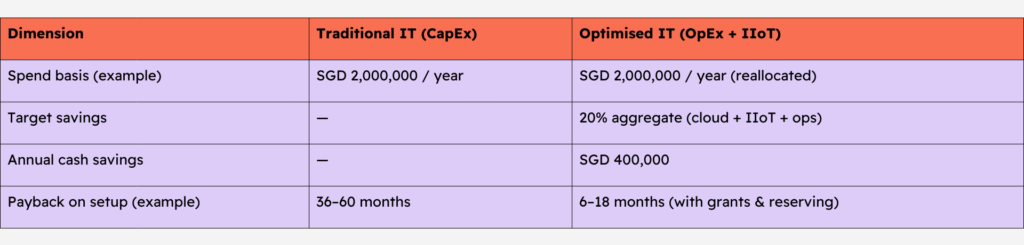
Achieved through: rightsizing + predictive maintenance + NOC optimisation. Combine with EDG/PSG grant support to accelerate payback period significantly.
Protecting the Savings You Capture
Security and resilience guard the returns from optimisation investments. Hidden costs of security incidents can erase the ROI of entire programmes. These six controls are non-negotiable for IIoT and hybrid infrastructure.
Key Controls — IIoT & Hybrid Infrastructure
- Segment IIoT networks from corporate IT using VLANs, firewalls, and zero-trust micro-segmentation.
- Enforce device authentication and strong identity for machines — mutual TLS, per-device certificates.
- Implement a regular patching cadence for OT gateways and edge appliances; automate wherever possible.
- Ensure 24×7 SOC/NOC monitoring for alerts, incident triage, and coordinated response across all sites.
- Maintain backups and disaster recovery runbooks — test them yearly against real RTO/RPO targets.
- Apply secure remote-management with role separation for vendor or third-party access to production systems.
Grants That Lower Your Implementation Cost
Singapore’s Enterprise Singapore programs are designed to lower the cost of digital transformation. Use these grants to offset implementation cost for pilot IIoT, automation, or cloud modernisation projects — often the difference between a 6- and 18-month payback.
Published Benchmarks That Anchor Your ROI Case
15–30% Per Unit Cost Savings and 50% Downtime Reduction Within 24 Months
Download the Singapore Manufacturing IT Optimisation Checklist — with prioritised levers, ROI benchmarks, and grant eligibility guidance for CIOs ready to act.
Download the Checklist →
Frequently Asked Questions
-
Typical IIoT deployments reduce unplanned downtime and maintenance costs. Published studies and vendor case materials commonly report 10–25% operational savings depending on asset criticality and maturity. For Singapore factories, pilot projects with clear KPIs help validate expected savings before scaling. IIoT World benchmarks ↗
-
Yes. Enterprise Singapore’s EDG and the PSG provide co-funding for transformation and productivity solutions, lowering capital barriers for pilots and scaled rollouts. Eligibility and subsidy levels vary by project type and firm size — check the official portals early in project planning. Enterprise Singapore ↗
-
Rightsizing plus reserved instances or savings plans commonly yield 20–30% first-year reductions for typical enterprise workloads. Deeper discounts (50%+) are possible with multi-year commitments or Savings Plans for stable workloads. Combine governance tools and tagging to capture and sustain savings beyond the initial implementation. AWS rightsizing guidance ↗
-
Start with a focused predictive maintenance pilot on one critical asset family, instrument with sensors, and route analytics alerts to a centralised NOC. Quick wins come from condition-based maintenance and automated alerts that prevent catastrophic failures. Measure MTTR and downtime before and after to quantify impact and build the ROI case for scale-up.
Ready to Cut IT Costs at Your Singapore Facility?
Softenger’s team can help you identify the right IIoT, AIOps, and cloud rightsizing levers for your specific production environment — with ROI benchmarks, grant-aligned delivery, and 24×7 NOC/SOC support.