

The SOC Maturity Framework 2026: Redefining Compliance and Audit Readiness
In 2026, Regulators Expect You to Prove Cyber Resilience — Not Just Claim It
As ISO 27001, GDPR, and NIST updates tighten evidence requirements, CIOs are under pressure to quantify the effectiveness of their Security Operations Centers (SOCs) using measurable, board-level metrics.
Traditional checklists are no longer enough. Enterprises need an integrated framework that ties detection performance, automation levels, and audit assurance to governance outcomes. The SOC Maturity Framework 2026 provides that roadmap — uniting ten domains of compliance capability into a single, auditable maturity model.
- The 2026 compliance imperative — three questions boards are asking SOC leaders
- All ten audit domains of the SOC Maturity Framework with practices, formulas, and metrics
- Key formulas: Detection Quality Index (DQI), Automation Ratio (AR), Risk Exposure Index (REI), SOC Maturity Index (SMI)
- Executive KPI benchmark table — 2025 baselines vs. 2026 targets
- The five-stage maturity ladder from Reactive to Predictive
Three Strategic Questions Boards Now Ask SOC Leaders
The rise of hybrid IT, multi-cloud, and continuous monitoring has blurred the line between operations and governance. Boards now expect quarterly SOC maturity briefings that answer three questions with quantified, auditable evidence.
- Q1 How fast can we detect and contain a threat? — Measured by MTTD and MTTR against contractual and regulatory benchmarks.
- Q2 How quickly can we prove compliance to auditors? — Measured by Evidence Delivery SLA and audit closure time.
- Q3 Where should we invest next to improve resilience ROI? — Answered by the SOC Maturity Index (SMI) across all ten domains.
The SOC Maturity Framework quantifies these answers through standardized KPIs:
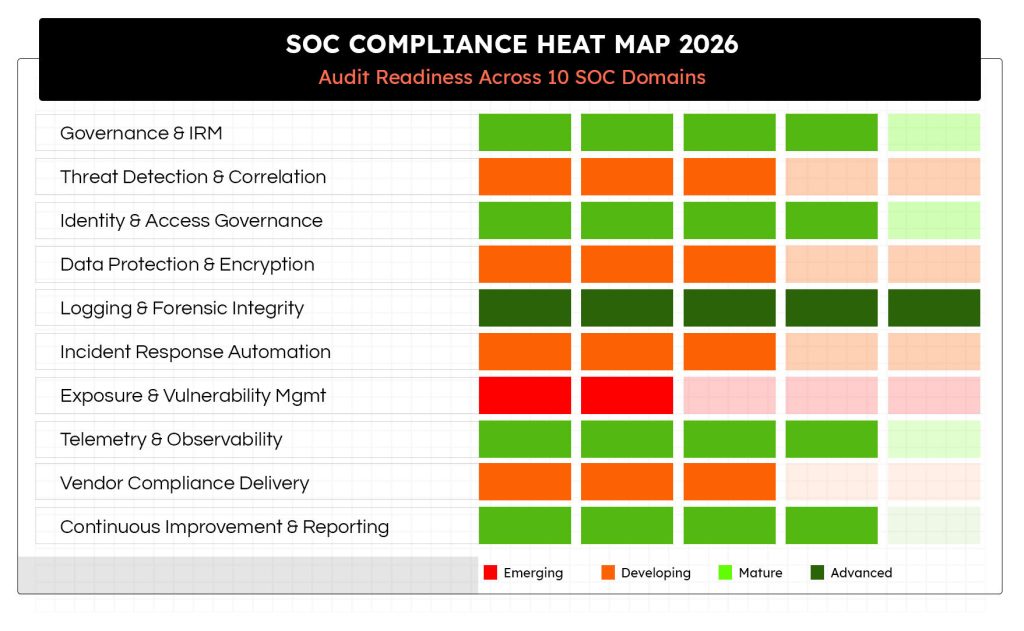
Ten Audit Domains — From Reactive Operations to Predictive Governance
Each domain represents a dimension of compliance performance. Together they form a single, auditable view of SOC maturity.
Why It Matters: Governance is the nucleus of audit maturity. In 2026, regulators expect risk data from SOCs to feed directly into enterprise risk dashboards — not remain siloed in security tools.
| Control Area | Audit Metric | Evidence Type |
|---|---|---|
| Policy Governance | % of controls with risk owner assigned | Control Register |
| Risk Linkage | IRM Dashboard populated | Risk Linkage Report |
| Audit Traceability | Frequency of policy reviews | Governance Report |
Maturity Indicator: Adoption of IRM practices that map operational metrics (MTTD, MTTR) directly to business risk indicators visible at board level.
Why It Matters: Detection is no longer about volume — it’s about confidence. Boards evaluate SOCs on how effectively they filter noise and surface true threats.
Best Practice: Correlate telemetry from endpoints, networks, and cloud platforms using unified analytics. Mature SOCs visualize residual risk per control domain to demonstrate compliance performance.
Why It Matters: Access risk is now an audit focus. 2026 frameworks such as NIST PR.AC and Zero Trust models assess how dynamically privileges adapt to context and sensitivity.
- Adoption of Cloud Infrastructure Entitlement Management (CIEM)
- Implementation of Adaptive MFA and risk-based access policies
- Continuous identity review aligned with critical data classification
Why It Matters: Auditors now demand verifiable encryption proof and data lineage visibility — not self-attestation.
- Automate encryption audit reports aligned to GDPR Art. 32 & ISO A.10
- Map data residency zones to compliance jurisdictions for cross-border clarity
- Apply tokenization and key-management rotation logs as evidence trail
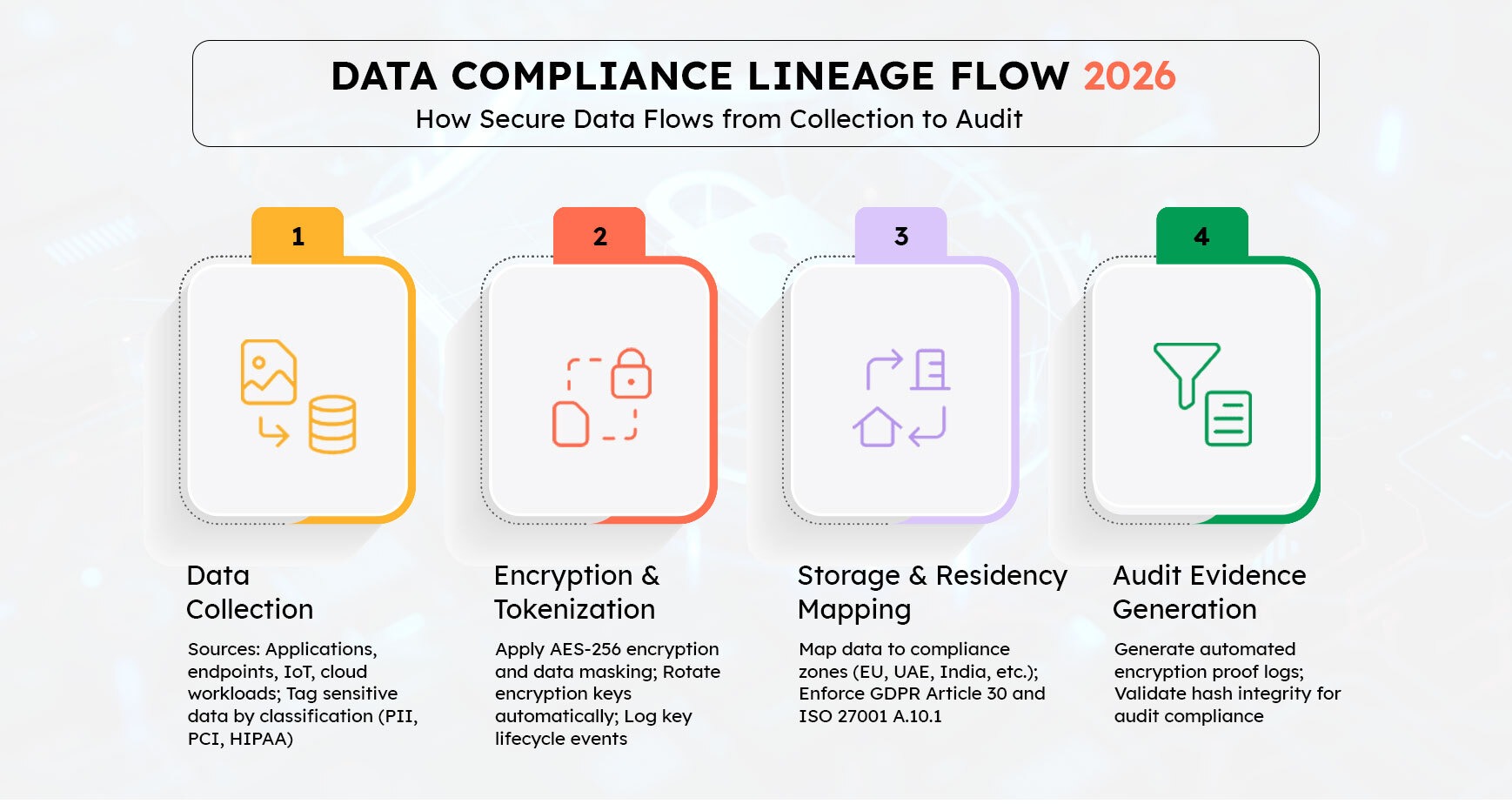
Business Outcome: Verifiable encryption audit trails reduce regulatory exposure and accelerate certification cycles.
Why It Matters: Logs are no longer just data — they are legal evidence. A 2026-ready SOC ensures log fidelity, immutability, and traceability across hybrid clouds.
- Implement WORM storage (Write Once, Read Many) for tamper-proof log retention
- Validate hash integrity of critical logs to detect any tampering
- Use forensic indexing to link events to compliance controls for audit traceability
Auditors are increasingly requesting proof of log integrity and evidence tamper detection. SOC teams with immutable log pipelines gain faster audit approvals and demonstrate stronger governance credibility.
Why It Matters: Response speed and repeatability define the credibility of a modern SOC. By 2026, regulators and insurers alike expect measurable evidence of automation maturity in IR workflows.
- Automate triage and containment through SOAR (Security Orchestration, Automation, and Response)
- Standardize incident categories with audit-ready playbooks
- Record all containment workflows for evidence traceability across compliance reviews
A mature SOC automates up to 70% of repetitive triage tasks, reducing MTTR below 3 hours and ensuring every action is logged for compliance verification.
Why It Matters: Patch frequency alone no longer defines maturity — exposure quantification does. SOCs are adopting Continuous Threat Exposure Management (CTEM) to measure residual risk.
- Integrate threat intelligence to correlate CVSS scores with exploit likelihood
- Report risk by business unit and compliance domain — not just by severity
- Align exposure reduction targets with board-level risk appetite
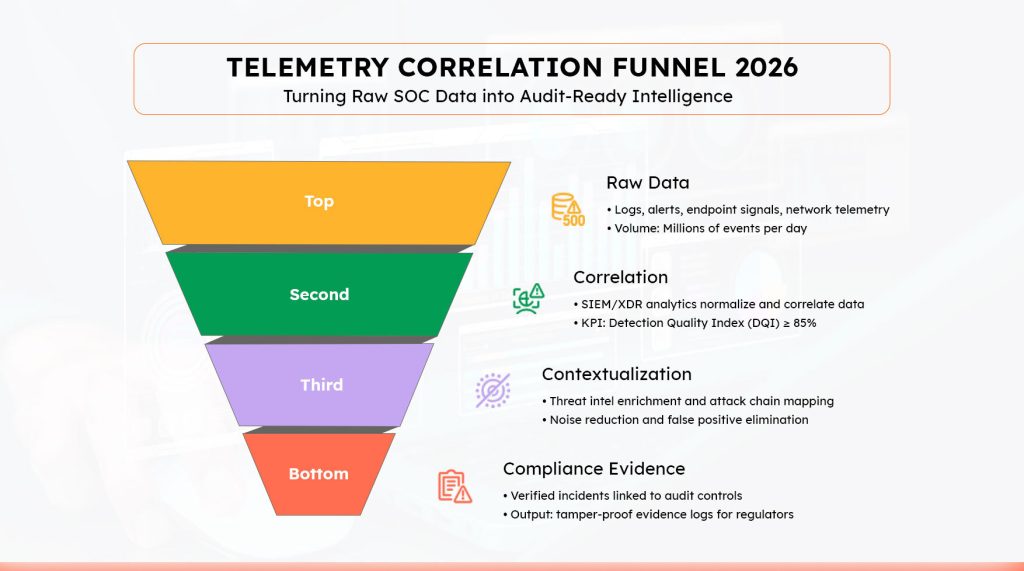
Why It Matters: Detection accuracy depends on telemetry normalization and visibility coverage. Auditors now request proof that every critical asset is monitored and every alert is traceable to a source.
- Normalize logs from endpoints, cloud, and OT systems for cross-correlation
- Achieve Detection Coverage ≥ 90% of all critical assets
- Document data lineage from raw event → correlated incident → compliance evidence
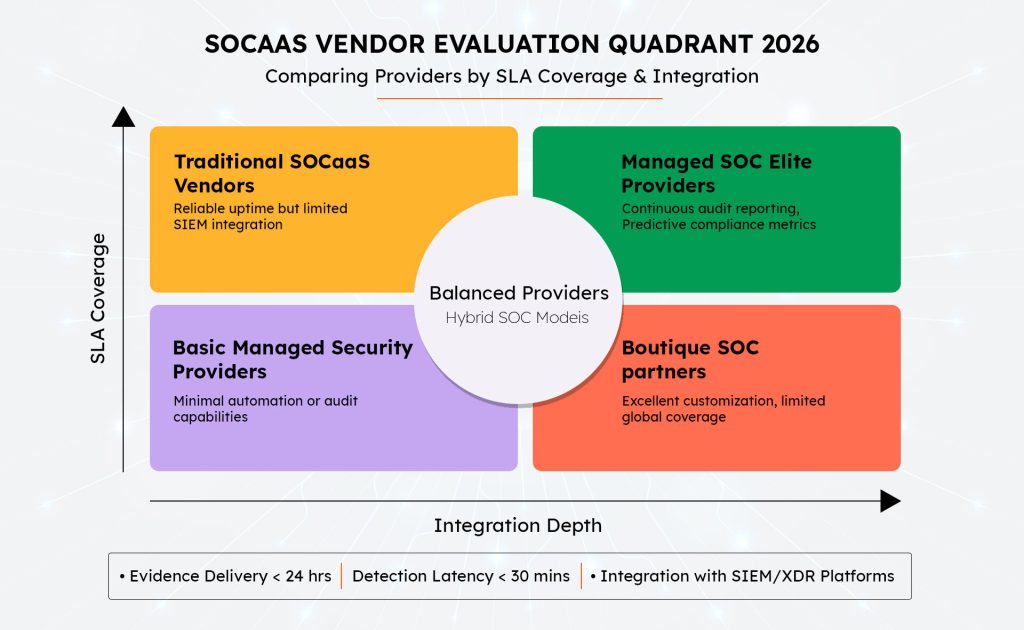
Why It Matters: Third-party SOCs are extensions of your compliance perimeter. The maturity focus has shifted from uptime SLAs to Compliance Delivery SLAs (CD-SLAs).
| Model | Control Assurance | SLA Transparency | Audit Maturity |
|---|---|---|---|
| In-house SOC | High | Moderate | Dependent on internal governance |
| Managed SOC | Medium | High | Structured audit reporting |
| Hybrid SOC | Very High | Very High | Integrated CD-SLA visibility |
CD-SLA Metrics to Track:
- Detection latency guarantees aligned to regulatory thresholds
- Evidence delivery time < 24 hours to auditors on request
- Monthly audit summaries with control-to-SLA mapping
Why It Matters: SOC maturity is an ongoing progression — the most resilient organizations treat compliance as a feedback loop, not a point-in-time audit exercise.
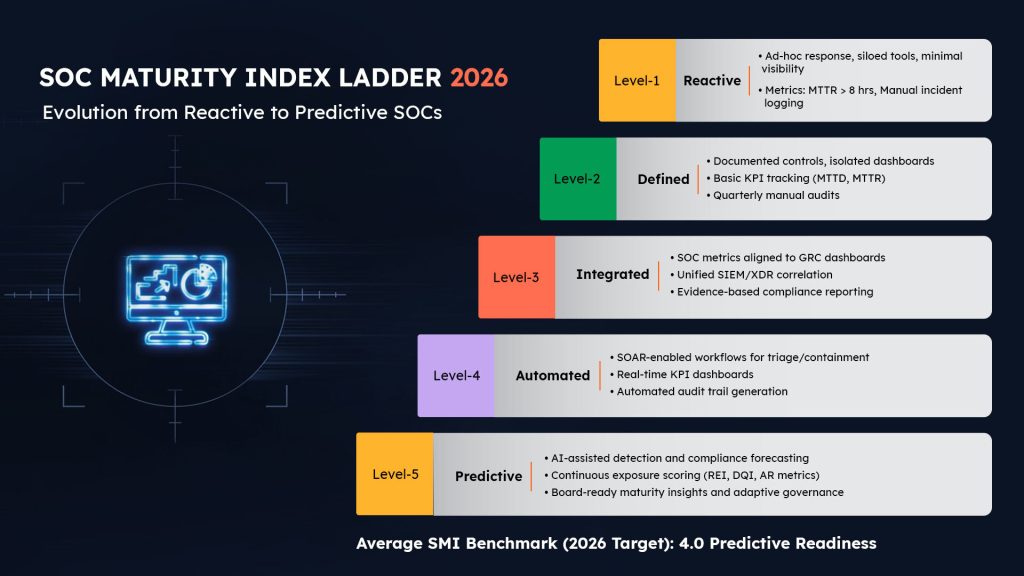
Five-Stage Maturity Ladder:
KPI Benchmark Table — 2025 Baselines vs. 2026 Targets
| Metric | 2025 Baseline | 2026 Target | Strategic Outcome |
|---|---|---|---|
| Detection Latency | 45 min | < 30 min | Faster containment |
| Automation Ratio (AR) | 40% | ≥ 65% | Reduced manual fatigue |
| Telemetry Coverage | 75% | ≥ 90% | Broader asset visibility |
| Evidence Delivery SLA | 48 hrs | ≤ 24 hrs | Audit agility |
| SOC Maturity Index (SMI) | 3.2 | ≥ 4.0 | Predictive compliance posture |
Source: SANS Incident Response Benchmarks 2024
Benchmark Your SOCaaS Providers for 2026 Compliance and Audit Confidence
Compare SOC providers against CD-SLA standards, evaluate audit maturity levels, and identify the right partner for your compliance posture.
Download the Benchmark Guide →
Need Help Strengthening Your SOC Compliance Posture?
Softenger’s cybersecurity specialists can assess your current SOC maturity against the 2026 framework — and build an audit-ready roadmap aligned to ISO 27001, NIST CSF, and GDPR.