


FinOps Readiness Self-Assessment for U.S. BFSI Cloud Cost Governance
Benchmark your organization’s FinOps maturity in under 15 minutes — scoring governance coverage, tagging compliance, rightsizing automation rate, and cost visibility to identify the exact gaps driving your cloud overspend.
- Four scored dimensions — governance coverage, tagging compliance, rightsizing automation rate, and cost visibility score
- Root cause diagnosis — identifies which of the three overspend drivers (AI/dev, storage/egress, governance gap) is your primary leak
- BFSI benchmark comparisons — how your FinOps maturity scores compare against U.S. BFSI industry baselines
- GLBA and FFIEC alignment check — compliance-aware FinOps controls specifically designed for regulated financial institutions
- Prioritized action steps — sequenced by savings impact, so your CIO and CFO agree on where to act first
Instant access. No spam. Softenger will never sell or share your information.
By submitting, you agree to Softenger’s Privacy Policy. You may unsubscribe at any time.
Assessment on its way
Check your inbox — we’ve sent the FinOps Readiness Self-Assessment to your work email. Didn’t receive it? Check your spam folder or contact us directly.
Four Dimensions of FinOps Maturity — Each One a Lever for Cost Recovery.
The self-assessment benchmarks your organization across four specific dimensions — each one directly correlated to cloud overspend risk. Your score across all four dimensions produces a FinOps Maturity Rating and a prioritized gap report.
Governance Coverage
Assesses whether your FinOps steering model exists, who owns it, and whether chargeback or showback reporting is active. The absence of a cross-functional FinOps steering committee is the single most common source of +30% budget overruns in BFSI environments.
Tagging Compliance
Measures resource tagging coverage and consistency across cloud environments. Without tagging, cost attribution is impossible — and without attribution, finance teams cannot connect cloud spend to business units, projects, or regulatory workloads.
Rightsizing Automation Rate
Scores the percentage of cloud compute and storage that is actively rightsized — and whether automated policies govern dev/test shutdowns, idle resource termination, and predictive scaling for production peaks. Manual rightsizing degrades rapidly.
Cost Visibility Score
Evaluates real-time spend tracking, Budget Variance Ratio, egress monitoring, and whether cost-to-income KPIs are reported to the board. BFSI organizations without real-time cost visibility are unable to respond to budget deviations before they become compliance exposures.
Three Workload Categories. All Three Driving Your Cloud Budget Overrun.
These are the 2025 BFSI average overspend figures by workload category — and what disciplined FinOps implementation typically recovers. The self-assessment identifies which category is your primary driver.
| Cloud Spend Category | Avg. Overspend (2025) | Recoverable Savings — With FinOps |
|---|---|---|
| AI & Dev Workloads | +18% | –20% after AIOps rightsizing |
| Storage & Egress | +25% | –15% after lifecycle automation |
| Governance Gap | +30% | –25% after FinOps adoption |
The Three Causes the Assessment Is Designed to Diagnose
Most BFSI cloud overspend is driven by one of three root causes — or a combination of all three. The self-assessment scores each one and tells you which to address first.
Ungoverned AI and Dev Workloads
AI experimentation and development environments that were never provisioned with governance controls — no auto-shutdown, no spend limits, no accountability. They scale freely and generate cloud bills that no one in finance can explain line by line.
Fix: AIOps rightsizing + dev/test shutdown policiesStorage and Egress Cost Accumulation
Compliance-mandated data retention in BFSI environments creates storage volumes that are predictable in size but not in cost. Egress fees from regulatory logging, cross-region replication, and backup pipelines compound quarterly without real-time alerting.
Fix: Storage lifecycle automation + egress monitoringNo FinOps Steering or Cost Accountability
Without a cross-functional FinOps steering committee — IT, finance, and compliance together — cloud spend has no owner. Business units request resources without cost visibility, and finance receives invoices without context. The Budget Variance Ratio grows unchecked.
Fix: FinOps governance + chargeback model + KPI frameworkThe FinOps Journey from Overspend to Controlled Cloud ROI
After completing the self-assessment, your scored gap report maps directly to this roadmap — showing which stages have been completed, which are in progress, and where the highest-impact actions sit on your 90-day plan.
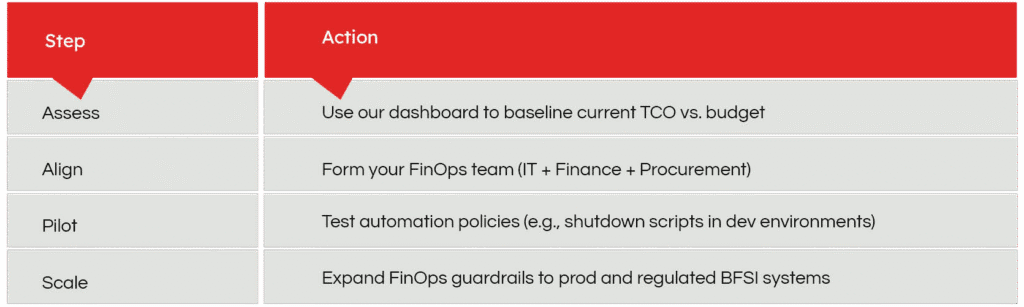
FinOps Roadmap — From Overspend to Controlled, Measurable Cloud ROI
FinOps for Regulated Financial Institutions
Every overspend lever in the assessment maps to a BFSI compliance consideration — storage lifecycle against GLBA data retention rules, egress costs against FFIEC audit log requirements, and governance coverage against both. The assessment includes compliance-aligned notes for each scored dimension.
Cloud Cost Control for U.S. BFSI — Built for Regulated Environments
Softenger delivers remote infrastructure management, FinOps consulting, and real-time cloud cost control for regulated industries. Our U.S.-focused BFSI solutions blend 24×7 support, transparent metrics, and compliance-aligned governance — built for environments where cloud spend and regulatory exposure are inseparable.
After completing the self-assessment, Softenger’s cloud cost specialists can benchmark your results against the BFSI industry, identify the three highest-impact optimisation opportunities, and outline a 90-day action plan in a 30-minute call — no slides, just your numbers.
- FinOps governance steering setup — cross-functional committee, chargeback model, and KPI framework
- AIOps-driven rightsizing across multi-cloud production, dev/test, and AI workloads
- Compliance-aligned cloud cost controls — GLBA and FFIEC aware from day one
- Free U.S. BFSI Cloud Audit — benchmark spend, identify top three optimisation opportunities
Common Questions
-
The assessment scores four dimensions of FinOps maturity: governance coverage (FinOps steering, chargeback model, KPI framework), tagging compliance (resource tagging across environments), rightsizing automation rate (AIOps-driven compute and storage optimization), and cost visibility score (real-time spend tracking and Budget Variance Ratio). It takes under 15 minutes to complete and produces a scored gap report with prioritized action steps.
-
The three primary root causes are: ungoverned AI and dev workloads generating +18% average overspend, storage and egress costs running +25% above budget due to compliance-mandated data retention, and lack of FinOps governance creating +30% budget overruns. The self-assessment identifies which of these three drivers is most significant in your specific environment — and what to address first.
-
Every scored dimension includes compliance-aligned notes for BFSI environments. Storage lifecycle automation is assessed against GLBA data retention obligations. Egress monitoring is evaluated in the context of FFIEC audit log requirements. Governance coverage scores factor in whether FinOps controls are structured to produce compliance-defensible cost documentation. The assessment is not a compliance audit — but it identifies the FinOps gaps that create compliance exposure.
-
U.S. BFSI organizations implementing FinOps governance, AIOps-driven rightsizing, and storage lifecycle automation typically achieve 25–30% cloud cost reductions within 12 months. A mid-sized U.S. retail bank documented a 28% reduction on a $4.5M annual cloud spend within 12 months, alongside a 40% decrease in compliance audit exceptions — achieved through FinOps steering, AIOps rightsizing, and egress automation simultaneously.
Want Your Assessment Results Benchmarked by a Specialist?
Download the self-assessment, complete it in 15 minutes, then book a free 30-minute FinOps strategy call with Softenger’s cloud cost specialists — your numbers, our benchmarks, and a clear 90-day action plan.