Secured and Streamlined Virtual Workload Migration
A life insurance company needed to migrate its entire virtual workload — including critical business applications — to a new data center. Zero downtime was non-negotiable. Sensitive insurance data had to be protected throughout. Softenger designed and executed the migration using Cisco UCS, Hyper-V Replication, SQL log shipping, and Unified Threat Management.
Secure Virtual Workload Migration — New Data Center
Moving critical insurance infrastructure — where failure isn’t an option
A life insurance company’s technology infrastructure is not a support function — it is the operating environment within which the core business runs. Policy administration, claims processing, agent portals, underwriting systems, and regulatory reporting all depend on continuous application availability. A data center migration in this context carries a different risk profile than a typical IT infrastructure project.
The client needed a new data center infrastructure that could serve both immediate operational needs and future growth — while ensuring that the transition from the old environment to the new one posed no risk to policyholder data, application continuity, or database integrity at any point during the migration window.
Migrate the entire virtual workload, including critical business applications, to a new data center. Ensure zero downtime during the transition to maintain business continuity. Strengthen cybersecurity measures to protect sensitive life insurance data during the migration process.
Ensuring Uninterrupted Operations for Critical Applications
The life insurance environment runs applications that cannot tolerate downtime — policy systems, claims platforms, and agent-facing tools are all live, customer-impacting, and time-sensitive. Any application interruption during migration would directly affect policyholders and generate regulatory exposure.
Zero Downtime · Application Continuity · Critical SystemsSynchronizing SQL Databases Across Locations to Maintain Data Integrity
The migration involved SQL databases carrying live transaction data — policy records, claims, premium payments. These databases had to be kept synchronized between source and destination environments throughout the migration period, with no data loss or divergence at the point of cutover.
SQL Synchronization · Log Shipping · Data IntegritySecuring Sensitive Insurance Data During Transfer
A data center migration creates a temporary expanded attack surface — data and workloads exist in two environments simultaneously, and data is actively moving between them. For a life insurance company holding policyholder personal and financial data, this window requires explicit security coverage, not just good intentions.
Data Security · UTM · Compliance RiskFour technologies — each solving one migration objective
The solution wasn’t a single product. It was a deliberate combination of four technologies, each selected to address one of the migration’s critical requirements. Cisco UCS for performance at the destination. Hyper-V Replication for workload continuity. SQL log shipping for database synchronization. UTM for security throughout. Together they covered every risk surface the migration presented.
Cisco UCS
Provides the optimized, scalable compute foundation at the new data center. Cisco UCS unifies compute, networking, and storage access — simplifying management at the destination while delivering the performance the migrated life insurance workloads require.
Hyper-V Replication
Continuously replicates virtual machine state from source to the new data center. At cutover time, a current replica is available — enabling rapid, low-disruption failover with minimal lag. This is the mechanism behind zero-downtime application migration.
Log Shipping
Continuously ships SQL transaction logs from source to destination databases — keeping them synchronized in near-real-time throughout the migration window. At cutover, database divergence is minimal. Policy records, claims, and premium data arrive intact.
UTM Solution
Provides unified perimeter security, intrusion prevention, and traffic monitoring across both source and destination environments throughout the migration window — protecting sensitive policyholder data at every point in transit and in both environments simultaneously.
How Hyper-V Replication and log shipping work together
The combination is critical: Hyper-V Replication handles the virtual machine layer — the operating system, application binaries, and configuration — while log shipping handles the data layer — the live transaction records in SQL. Without both working in parallel, a zero-downtime cutover isn’t achievable on a live database-backed application. One synchronizes the compute; the other synchronizes the data it serves.
Why UTM was required — not optional — for this migration
During a data center migration, the security perimeter is temporarily expanded: both environments are live, data flows between them, and the configuration state of both is in flux. For a life insurance company with regulatory obligations around policyholder data, this window cannot be left to standard firewall coverage alone. UTM provides the unified visibility and threat management layer that keeps sensitive data protected throughout the transition.
Four solutions — each one closing a migration risk
The solution architecture was built around the client’s three requirements — continuity, data integrity, security — with a fourth element added to align the new infrastructure with future growth needs. Every technology decision was made to serve a specific risk or requirement, not to demonstrate technical capability for its own sake.
The Tier 1 System Integrator partnership was more than vendor co-ordination. The SI brought hardware procurement, infrastructure design validation, and post-migration support capabilities that complemented Softenger’s migration execution expertise. The combined engagement gave the client a single point of accountability for both the infrastructure design and the migration itself.
The architecture decision most critical to the project’s success was Hyper-V Replication combined with log shipping — the specific pairing that made zero-downtime achievable for a database-backed application estate. Neither alone would have been sufficient for a life insurance workload.
Cisco UCS — Secure, Scalable Data Center Foundation
Designed and built the new data center infrastructure using Cisco UCS to optimize performance and scalability for the migrated life insurance workloads.
- Cisco UCS provides unified management of compute, networking, and storage at the new data center
- Infrastructure sized for current workload requirements and designed to scale for future growth
- Performance optimization for the specific application profiles of life insurance systems
- Architecture validated with Tier 1 SI to ensure alignment with long-term infrastructure roadmap
Hyper-V Replication + Log Shipping — Zero-Downtime Migration
Used Hyper-V Replication with SQL log shipping for continuous synchronization of both virtual machine state and database data — enabling a rapid, low-disruption cutover.
- Hyper-V Replication keeps VM state synchronized between source and new data center throughout migration
- SQL log shipping continuously ships transaction logs — databases stay synchronized in near-real-time
- Combined approach enables cutover with minimal lag — application and data both current at the moment of transition
- Application failover capability built in — recovery path available if any issue arises during cutover
UTM Implementation — Security Throughout the Migration Window
Implemented a Unified Threat Management solution to provide comprehensive security coverage across both environments during the migration — protecting sensitive life insurance data throughout.
- UTM deployed across both source and destination environments — unified visibility into all traffic
- Intrusion prevention active throughout the migration window — no gap in perimeter security
- Traffic monitoring covers data-in-transit between environments — policyholder data protected end-to-end
- Post-migration: UTM remains as the ongoing security layer for the new data center environment
Tier 1 SI Partnership — Future-Aligned Architecture
Partnered with a Tier 1 System Integrator to ensure the migration and new data center design aligned with the client’s future growth requirements and infrastructure strategy.
- SI engaged for hardware design, procurement, and infrastructure validation at the new data center
- Combined Softenger and SI expertise provided end-to-end coverage — migration execution and infrastructure design
- Future growth requirements incorporated into the architecture — no re-engineering needed as the business scales
- Single point of accountability for both migration delivery and post-migration infrastructure support
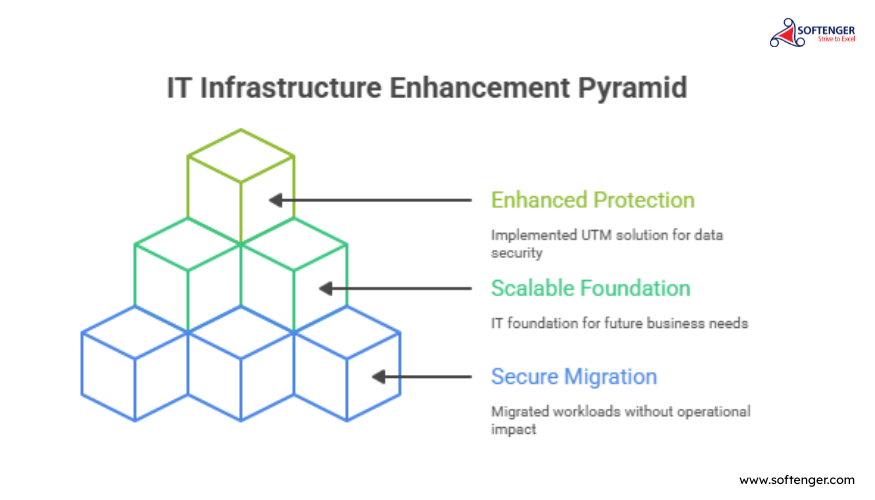
Three outcomes — each one a direct answer to the three challenges
The challenge was continuity, data integrity, and security. The outcomes were zero-impact migration, a robust scalable foundation, and enhanced data protection. One-to-one correspondence between the problem statement and the result.
Secure, Efficient Migration — Zero Operational Impact
The virtual workload migration was delivered without impacting ongoing operations. Life insurance applications remained available throughout the migration window. Policyholders, agents, and internal teams experienced no disruption from the data center transition.
Robust and Scalable IT Foundation
The Cisco UCS infrastructure at the new data center — designed with the Tier 1 SI — provides the foundation for the client’s current operational requirements and their anticipated future growth. The architecture doesn’t need to be re-engineered as the business scales.
Enhanced Data Protection via UTM
Sensitive life insurance and policyholder data was protected throughout the migration by the Unified Threat Management solution — deployed across both environments and active during every phase of the workload transfer. Post-migration, the UTM remains as the ongoing security layer for the new environment.
Key Takeaway
This project showcases Softenger’s ability to deliver seamless and secure virtual workload migrations for critical industries like life insurance. Leveraging advanced technologies and close collaboration with the client and Tier 1 SI, Softenger ensured a smooth transition to the new data center — protecting sensitive data, maintaining operational continuity, and building an infrastructure foundation that the client can grow into for years ahead.
Why a Tier 1 SI partnership changed what was achievable
A data center migration at this level of criticality — life insurance, active databases, zero-downtime requirement — requires two distinct capabilities working together: the infrastructure design and hardware expertise of a Tier 1 SI, and the migration execution discipline of an experienced IT services partner.
Softenger brought the migration architecture, the replication and synchronization methodology, and the security coverage. The SI brought hardware design, validated reference architectures for Cisco UCS, and the procurement and deployment capability for the physical data center layer. Neither could have delivered the full engagement alone.
SI Contributed: Infrastructure Design & Hardware
Cisco UCS reference architecture, hardware procurement, physical data center build-out, and validated infrastructure design aligned to the client’s growth roadmap.
Softenger Contributed: Migration Execution
Hyper-V Replication configuration, SQL log shipping setup, UTM deployment and coverage, migration sequencing, cutover coordination, and validation.
Combined: Single Accountability for the Client
The client had one coordinated engagement team responsible for both the infrastructure destination and the migration process — eliminating the gaps and finger-pointing that multi-vendor migrations often produce.
Every engagement follows the AOTS framework
This migration followed Softenger’s AOTS model precisely. The Advise phase made the critical architecture decision: Hyper-V Replication combined with log shipping — not one or the other. That decision was the technical foundation of zero-downtime delivery. The Optimize phase configured both replication tracks. The Transform phase executed the migration and cutover. The Support phase maintains the new environment and its UTM security layer.
The AOTS insight for data center migrations: the Transform phase is not where the risk is managed — the Advise phase is. By the time Softenger was executing the migration, every risk had already been identified and a mitigation had been designed. The execution proceeded as planned because the plan was thorough.
Advise
Workload assessment — application inventory, database mapping, dependency documentation. Cisco UCS architecture designed. Hyper-V + log shipping approach selected. UTM coverage model defined. SI engagement structured.
Full architecture approved. Replication strategy confirmed. UTM deployment plan agreed. Migration sequencing defined before any change was made.
Optimize
Cisco UCS infrastructure built and validated at the new data center. Hyper-V Replication configured and initial synchronization completed. SQL log shipping established and verified. UTM deployed and tested across both environments.
All four technologies operational. Replication running. Log shipping current. UTM active. Migration readiness confirmed before cutover window.
Transform
Cutover executed within the agreed maintenance window. VM failover via Hyper-V Replication. Database cutover with minimal SQL lag. Applications verified operational on new infrastructure. Zero downtime confirmed.
Full virtual workload live on new data center. Zero operational impact. Life insurance applications fully operational. Migration complete.
Support
Post-migration validation of all workloads. UTM security active in the ongoing environment. Cisco UCS performance monitoring established. SI support structure for infrastructure maintenance. Client teams transitioned to operating the new environment.
New data center fully operational. Security maintained. Scalable foundation in place. Client teams equipped for ongoing operations.
The AOTS model is applied to every Softenger engagement
Life insurance data center migrations, DR orchestration, OS migrations, network change management, banking automation — the same four-phase discipline structures every engagement Softenger delivers.
Questions about virtual workload migration
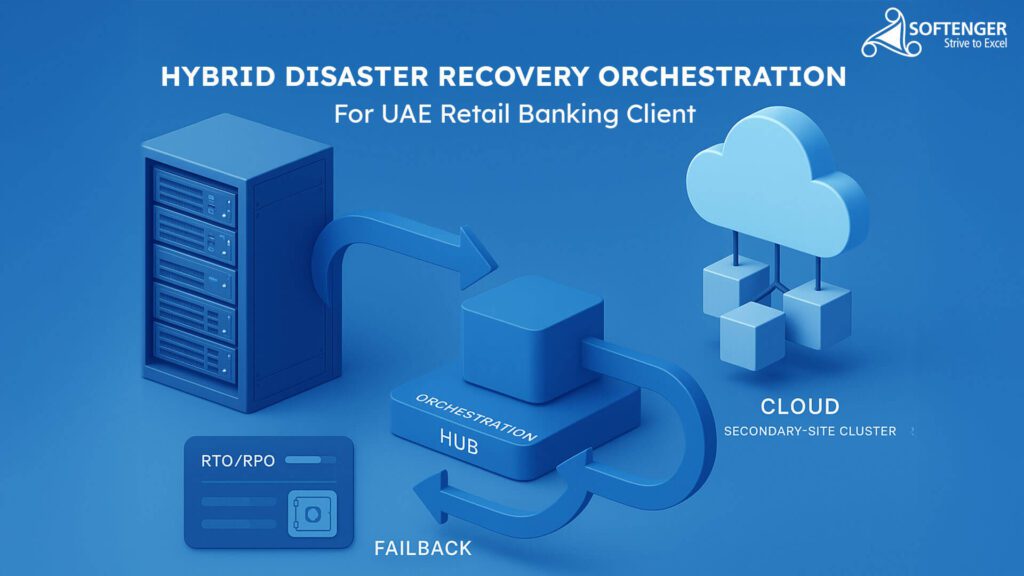 Disaster Recovery
DR Orchestration for a Leading UAE Retail Bank
Kyndryl Cloud Resiliency Orchestration implemented for a UAE retail bank — 50% reduction in DR drill times, Central Bank UAE compliance achieved, Finacle core banking pilot expanded across the application estate.
 IT Infrastructure
Streamlined Virtual Infrastructure
280+ VMware ESXi physical servers upgraded and aligned to vCenter 6.7 VCSA — version fragmentation eliminated, inventory integrity restored, and monitoring systems realigned across the full estate.
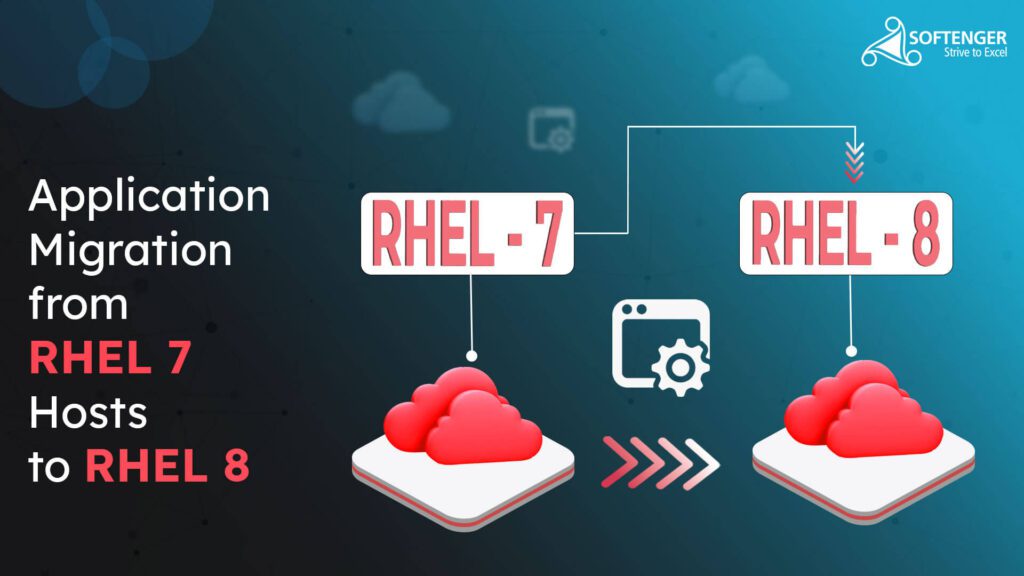 OS Migration
Application Migration — RHEL 7 to RHEL 8
Phased migration from RHEL 7 to RHEL 8 — application compatibility assessment, risk-tiered sequencing, automation scripting, and thorough validation with minimal business disruption.
Tell us what’s moving — and what you can’t afford to disrupt.
Whether it’s a full data center migration for a regulated financial services client, a hybrid cloud transition, a disaster recovery site setup, or a virtualisation consolidation — Softenger has the architecture, the technology pairing, and the execution discipline to deliver it without operational impact. A conversation with one of our infrastructure specialists starts with your risk profile, not a product recommendation.
🔄 Discuss a Migration Project
ISO 27001 certified. Your information is handled securely and never shared.