

How 83% of U.S. BFSI CIOs Are Overspending on Cloud — and How FinOps Fixes It
The Widening Cloud Spend Gap in U.S. BFSI
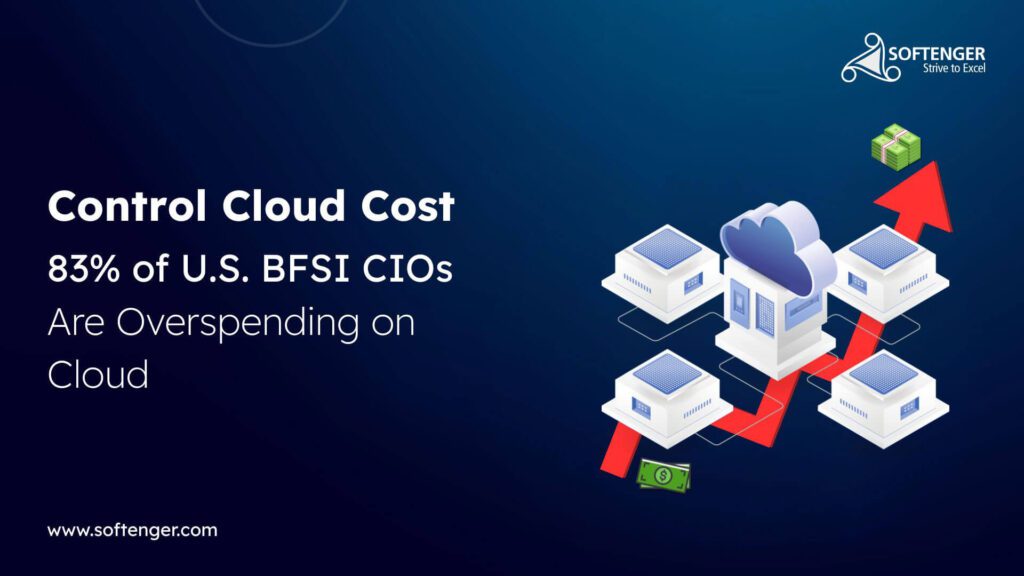
A recent Azul survey of 300 U.S. CIOs revealed a staggering fact: 83% are overshooting their cloud budgets by ~30% on average. For U.S. banks and financial institutions (BFSI), these overruns don’t just strain IT budgets — they create compliance concerns under GLBA and FFIEC, weaken cost-to-income ratios, and put pressure on margins.
This post unpacks the key drivers of overspend and offers three proven FinOps-led strategies that CIOs can adopt to reduce cloud costs by 25–30%. We also share Softenger’s Cloud Cost Transparency Dashboard to help CIOs benchmark current spending.
- The three structural drivers behind BFSI cloud budget overruns
- Three proven FinOps-led strategies to cut cloud spend by 25–30%
- Real-world success snapshot — a mid-sized U.S. retail bank’s 28% cost reduction
- Cloud Cost Transparency Dashboard — benchmarks, ROI visibility, self-assessment
- Quick benchmark table — overspend vs. optimized costs by workload category
- Next steps for BFSI CIOs ready to act now
What’s Driving Overspend in BFSI Cloud Environments
Cloud adoption is no longer optional for BFSI. From mobile banking apps to AI-driven fraud detection, workloads are exploding. Yet uncontrolled growth introduces financial blind spots — and three structural drivers account for the majority of overspend:
BFSI organizations are rapidly scaling AI/ML and developer sandboxes. But without usage limits, projects consume compute hours far beyond business value. Dev workloads left unchecked can account for 15–20% of wasted spend annually.
Impact: 15–20% wasted spend annually · CloudZero, 2025Without proper tagging and showback/chargeback models, CIOs struggle to identify which departments drive usage. In many banks, IT and finance teams work in silos, leading to unmonitored consumption. According to CIO.com, inadequate governance is a top barrier to effective FinOps adoption in BFSI.
Impact: Budget misalignment, late CFO escalations, audit risksUnplanned data egress, frequent backups, and unused block storage inflate monthly invoices. For BFSI, where compliance requires extensive logs and data retention, storage costs can silently grow by 25% year-over-year unless optimized.
Impact: Storage costs growing 25% YoY without interventionCloud spend is ballooning as banks adopt AI-based fraud detection, real-time analytics, and dev/test automation pipelines — but without governance, growth and waste are indistinguishable.
Three Proven Tactics to Cut Cloud Spend by 25–30%
These three strategies work together — each one closes a different gap in the BFSI cloud spend problem. Implemented in combination, they consistently produce 25–30% cost reductions within a year.
The FinOps USA model emphasizes cross-functional collaboration between IT, finance, and compliance. CIOs should:
- Establish a FinOps steering committee with representation from IT, finance, and procurement
- Set KPIs — e.g., % workloads tagged, cost-per-transaction, Budget Variance Ratio
- Adopt showback/chargeback reporting to create departmental accountability for cloud consumption
Embedding governance ensures cloud spending aligns with business outcomes, not unchecked demand.
Enables real-time financial governance over regulated workloads — fraud monitoring, KYC pipelines, and compliance-sensitive data lakes — where uncontrolled spend creates audit exposure, not just budget variance.
Rightsizing means matching workloads to optimal instance sizes. Manual reviews are error-prone, but AIOps-driven automation can dynamically scale compute, storage, and network usage. Examples include:
- Shut down dev/test environments outside working hours — eliminating 100% of idle compute spend on those workloads
- Use predictive scaling to avoid over-provisioning ahead of anticipated traffic peaks
- Integrate cloud cost management services for workload-level optimization continuously, not quarterly
Banks that adopt rightsizing typically save 20–25% of monthly cloud costs. (CloudZero, 2025)
Matches infrastructure scale with peak transaction cycles — improving ROI without risking the uptime that customer-facing banking services demand at all hours.
Lifecycle automation is critical in BFSI — where compliance mandates create large volumes of data that still need to be stored cost-efficiently:
- Automate log retention policies to shift old data to cheaper storage tiers automatically
- Deploy egress monitoring rules with real-time alerts before surprise invoices arrive
- Enforce auto-archival policies for non-critical workloads — compliance retained, cost reduced
Together, these steps can cut storage costs by 15–20% while maintaining full compliance posture.
Prevents regulatory budget breaches and streamlines audit preparation — turning storage compliance from a cost amplifier into a managed, predictable line item.
28% Cost Reduction in 12 Months: A U.S. Retail Bank
The three tactics above aren’t theoretical — they produced documented results at a mid-sized U.S. retail bank that had allowed cloud spend to scale without governance controls.
Mid-Sized U.S. Retail Bank — $4.5M Spend Brought Under Control
This before-and-after shows how even conservative BFSI adopters can capture significant savings while improving governance — the two outcomes are not in tension when FinOps is implemented correctly.
Download: Cloud Cost Transparency Dashboard & Self-Assessment
Softenger has developed a Cloud Cost Transparency Dashboard tailored for U.S. BFSI CIOs. Inside, you’ll find current overspend benchmarks by workload type, ROI visibility for FinOps actions, and a quick FinOps Readiness Self-Assessment to evaluate your organization’s cloud maturity.
Cloud Cost Audit & Dashboard Template
TCO per environment, ROI per workload, cost-per-transaction, Budget Variance Ratio, and real-time deviation alerts — all in one template.
Download →FinOps Readiness Self-Assessment
Benchmark your organization’s FinOps maturity — governance coverage, tagging compliance, rightsizing automation rate, and cost visibility score — in under 15 minutes.
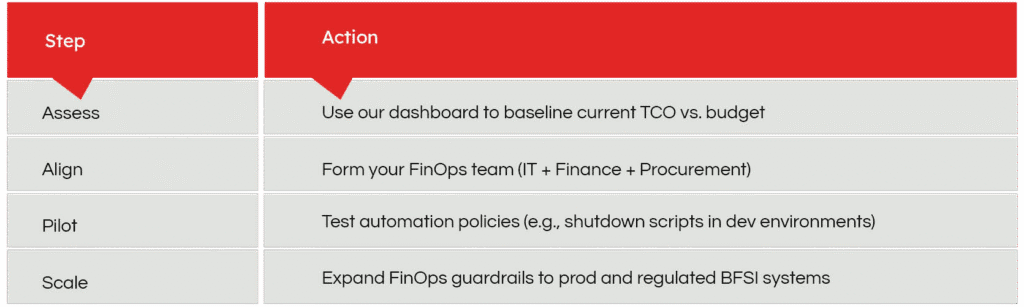
Download →From Overspend to ROI: The FinOps Journey Mapped
Cloud overspending in U.S. BFSI isn’t just an IT issue — it’s a board-level priority impacting compliance, resilience, and profitability. CIOs who adopt FinOps governance, AIOps-driven rightsizing, and automation can achieve 25–30% cost reductions in under a year. The roadmap below maps each stage:
BFSI Cloud Overspend vs. Optimized Costs
Three workload categories drive the majority of BFSI cloud overspend. Here is what average overspend looks like — and what disciplined FinOps implementation typically recovers:
| Cloud Spend Category | Avg. Overspend (2025) | Optimized Savings (with FinOps) |
|---|---|---|
| AI/Dev Workloads | +18% | –20% after rightsizing |
| Storage & Egress | +25% | –15% after automation |
| Lack of Governance | +30% | –25% after FinOps USA adoption |
Cloud Cost Control for Regulated Financial Institutions
Softenger delivers remote infrastructure management, FinOps consulting, and real-time cloud cost control for regulated industries. Our U.S.-focused BFSI solutions blend 24×7 support, transparent metrics, and compliance-aligned governance — built specifically for environments where cloud spend and regulatory exposure are inseparable.
-
FinOps Governance & Steering Cross-functional FinOps steering committee setup, tagging policies, showback/chargeback reporting, and KPI frameworks aligned to GLBA and FFIEC requirements.
-
AIOps-Driven Rightsizing Automated rightsizing across multi-cloud environments — compute, storage, and network — with scheduled shutdown policies for dev/test and predictive scaling for production peaks.
-
Compliance-Aligned Cloud Cost Control Real-time egress monitoring, storage lifecycle automation, and cost threshold alerting — designed for BFSI compliance environments where every log and backup has regulatory implications.
-
Free U.S. BFSI Cloud Audit Schedule a free cloud audit and ROI strategy session — we’ll benchmark your current spend, identify the three highest-impact optimization opportunities, and outline a 90-day action plan.
Cloud Spend Is Controllable — When CIOs Act on the Right Levers
Cloud overspending in U.S. BFSI isn’t just an IT issue — it’s a board-level priority impacting compliance, resilience, and profitability. CIOs who adopt FinOps governance, AIOps-driven rightsizing, and automation can achieve 25–30% cost reductions in under a year.
-
Download the Cloud Cost Dashboard Benchmark your current spending by workload type and identify the highest-impact optimization opportunities immediately. → Download the Dashboard Template
-
Book a FinOps Readiness Call A 30-minute strategy session with Softenger’s cloud cost specialists — no slides, just your numbers, our benchmarks, and a clear action plan. → Schedule a Call
-
Request a Free BFSI Cloud Audit Full analysis of your current cloud architecture against FinOps best practices — governance gaps, rightsizing opportunities, egress risks — with a prioritized remediation roadmap. → Request the Audit
Cloud Cost Optimization for BFSI — Frequently Asked Questions
-
The best strategies include FinOps governance, AIOps-driven rightsizing, and lifecycle automation. Together, these tactics can reduce BFSI cloud spend by 25–30% while improving compliance visibility — addressing governance, workload efficiency, and storage control simultaneously.
-
Overspending often stems from unmonitored AI/dev workloads, lack of tagging and cost visibility, and unexpected egress fees. Without FinOps governance, CIOs struggle to connect usage with business outcomes — and the gap between spend and value widens with every new AI initiative or compliance workload added to the environment.
-
The FinOps USA model enables collaboration across IT, finance, and compliance teams. It helps CIOs track cloud spend, set cost-to-income KPIs, and enforce accountability through chargeback models — creating a governance structure where cloud consumption is tied to business outcomes, not just invoices.
-
Yes. CIOs should benchmark cost-per-transaction and workload TCO before and after optimization. Banks adopting FinOps often report 20–30% reductions in OpEx within the first year — with the Cloud Cost Transparency Dashboard providing the before-state baseline and quarterly tracking thereafter.
-
Softenger offers dedicated Cloud cost management services and a FinOps Readiness Self-Assessment to help BFSI leaders regain financial control. Contact Softenger to schedule your free U.S. BFSI Cloud Audit and ROI Strategy Session.
Ready to Cut Your Cloud Spend by 25–30%?
Cloud overspending in U.S. BFSI isn’t inevitable — it’s a governance and visibility problem. Softenger’s FinOps-led approach gives CIOs the tools, benchmarks, and expert support to regain financial control without compromising compliance or uptime.