


Large-Scale Network
Configuration Change
A leading telecom operator needed to realign its entire Cisco router estate to updated network policies — across 2,000 to 3,000 routers, 100 physical sites, spread across India. Manual reconfiguration wasn’t an option. Softenger automated the entire program using Shell scripting, standardized templates, and real-time monitoring — with minimal downtime.
Cisco Router Re-Configuration — PAN India, 100 Sites
The scope that makes manual execution impossible
A national network estate — and no scalable way to change it
Network policy updates are routine in telecom. Executing those updates across 2,000 to 3,000 physical routers distributed across 100 sites in different parts of India is not routine — it’s a change management program of a different order of magnitude. Every router needs to receive the same configuration change. Every site has its own local network environment. And every change carries downtime risk if it’s not executed and validated correctly.
The client’s business need was straightforward: align the entire Cisco router estate to updated network policies, improve network performance, and do it without disrupting operations at 100 live sites. The execution challenge was that no manual approach could reliably deliver consistency, speed, and low risk at this scale simultaneously.
Reconfigure a large number of Cisco routers across multiple sites in India to align with updated network policies and enhance network performance. Implement a standardized and efficient change management process to minimize disruptions and ensure consistency across all routers and sites.
Coordinating Across 100 Sites in Different Locations
Each physical site had its own local IT team, its own maintenance window constraints, and its own network environment characteristics. Coordinating a synchronized, consistent change program across all of them required a structured coordination model — not just a central script execution.
Geographic Coordination · 100 SitesEnsuring Configuration Consistency Across 2,000–3,000 Devices
The same policy changes needed to land correctly on every router, across hardware generations, site configurations, and varying network environments. A single templating inconsistency applied at scale would mean thousands of misconfigured devices — with no simple rollback.
Configuration Consistency · Template ManagementManaging and Automating at Router Volume
At 2,000–3,000 routers, manual configuration is not viable — even at eight hours a day, a team would need months to touch every device. Automation wasn’t an enhancement; it was the only delivery mechanism that could execute this program within any realistic timeframe.
Automation · Volume · Batch ProcessingMinimizing Downtime Across Live Network Infrastructure
Every router being reconfigured is carrying live telecom traffic. A failed or partial configuration push doesn’t just affect one site — in a telecom network, it can cascade. Every change window had to be coordinated, validated in real time, and recoverable if something deviated from the expected state.
Downtime Risk · Live Network · Change WindowsThree tracks — automate, standardize, monitor
The solution wasn’t a single script. It was three parallel workstreams that each addressed a different dimension of the problem: automation handled the execution volume, standardization handled consistency, and monitoring handled validation and real-time status. All three were required simultaneously.
The batch processing approach within the automation track was a critical design decision. Rather than pushing all changes simultaneously — which would have created an unmanageable failure surface — routers were updated in controlled batches, with monitoring validation between each batch before the next proceeded.
Local IT team coordination was equally important. Site-specific requirements couldn’t be discovered remotely — they had to be surfaced by the people on the ground at each location before the change window opened. Softenger’s coordination model ensured that knowledge was captured and incorporated into each site’s configuration variant before automation ran.
Automated Reconfiguration
Shell scripts developed to automate the reconfiguration process for Cisco routers — ensuring consistency and efficiency across all devices through batch processing.
- Shell scripts connect to each router, push pre-validated configuration changes, and log the outcome
- Batch processing — routers updated in controlled groups, not all simultaneously
- Each batch validated before the next batch proceeds
- Scripts tested on a subset of devices before full rollout
- Manual error eliminated from the configuration process entirely
Standardization & Coordination
Standardized configuration templates established as the baseline, with local IT team coordination at each site to handle site-specific network requirements.
- Standardized templates covering all policy changes applicable uniformly across routers
- Template variants developed for site-specific requirements while preserving the policy baseline
- Pre-change coordination with local IT teams at each of the 100 sites
- Site-specific requirements captured before change windows open — not discovered during execution
- All configuration changes validated against policy requirements before deployment
Monitoring & Validation
Monitoring scripts tracking reconfiguration progress in real time — validating configuration success per device and providing status reporting throughout the rollout.
- Monitoring scripts track each router’s configuration status through the change window
- Success validation confirms the correct configuration state after each device update
- Real-time status reporting — progress visible to stakeholders throughout the rollout
- Deviations from expected configuration flagged immediately — before they can cascade
- Post-change reporting confirms full rollout completion and policy compliance
Shell scripting — why it was the right tool at this scale
At 2,000–3,000 routers across 100 sites, the automation layer needed to be lightweight, reliable, and Cisco-native. Shell scripting — connecting to each router via SSH, executing configuration commands, and capturing the output — provided exactly that without requiring a third-party automation platform to be deployed and managed across the client’s network estate.
Scripts were developed to handle the full change lifecycle per device: connect → validate current state → apply configuration → verify new state → log outcome → flag deviations. The batch processing wrapper controlled the pace — ensuring that a failure on one router in a batch triggered a hold before the next batch ran.
Batch Processing — Controlled Pace
Routers were grouped into batches by site and processed sequentially. Each batch was validated before the next began — preventing a configuration issue from propagating across the full estate before it was caught.
SSH-Based Configuration Push
Scripts connected to each Cisco router via SSH, executed the standardized configuration commands using the Cisco IOS CLI, and captured the return output for validation — no manual console access required at any site.
Pre- and Post-State Verification
Each script run captured the router’s configuration state before and after the change. Post-change state was compared against the expected template output — any deviation flagged and halted the batch before the next device was touched.
Comprehensive Execution Logging
Every router interaction — connection, configuration push, validation result, and outcome — was logged to a structured file per batch. Logs gave stakeholders a complete audit trail of the entire reconfiguration program on completion.
Automatic Halt on Deviation
If any router in a batch returned an unexpected state, the script halted the batch and raised an alert before proceeding. This contained any failure to the current batch — protecting the remaining routers in the program while the deviation was investigated.
What the rollout produced — across all 100 sites
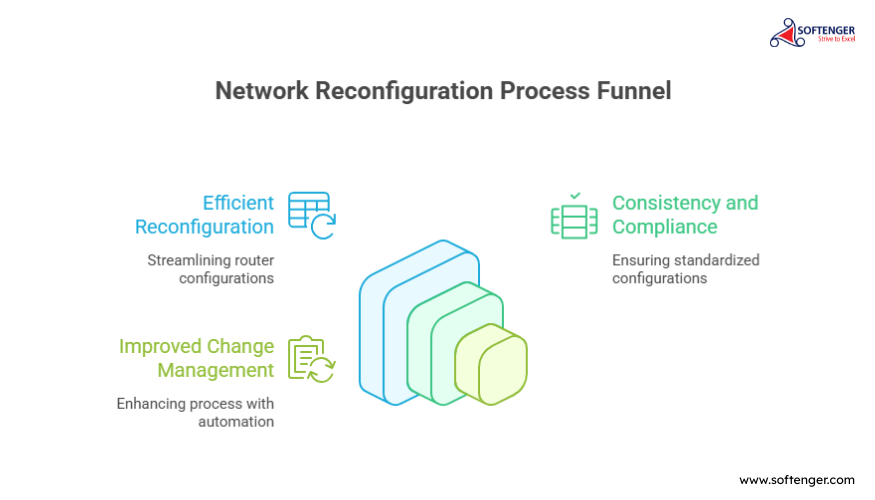
The three outcome categories map directly to the three challenges the program was designed to solve: execution efficiency, consistency and compliance, and improved change management capability going forward.
Efficient Reconfiguration at Scale
Consistency and Policy Compliance
Improved Change Management Capability
Key Takeaway
This project demonstrates Softenger’s expertise in managing large-scale network configuration changes through automation and standardized processes. By leveraging Shell scripting for automation, Softenger efficiently handled the reconfiguration of 2,000–3,000 routers across 100 physical sites — minimizing disruptions, ensuring consistency, and enhancing overall network performance and operational efficiency for a national telecom leader.
Every engagement follows
the AOTS framework
The network configuration rollout followed Softenger’s four-phase AOTS model from first call to final validation. The Advise phase defined what could go wrong at this scale — and designed the safeguards before a single script ran. Optimize built the automation. Transform executed the rollout. Support provided the monitoring, deviation response, and post-change reporting that closed the program cleanly.
The most important Advise-phase decision: batch processing with pre-validated halt conditions. Pushing all 3,000 routers simultaneously would have been faster — and potentially catastrophic. The controlled batch approach meant that any failure was contained, investigated, and resolved before it could propagate across the network estate.
Advise
Assessed the scope: 2,000–3,000 routers, 100 sites, PAN India. Defined batch size and sequencing. Designed halt conditions. Coordinated with local IT teams to surface site-specific requirements before scripts ran.
Full scope defined. Batch processing model designed. Site-specific requirements captured. Template variants validated before rollout began.
Optimize
Shell scripts developed and tested on a subset of devices. Standardized configuration templates built and validated. Monitoring scripts written and tested. Batch sequencing finalized against the site schedule.
Scripts tested and validated. Templates approved. Monitoring operational. Change windows agreed with all 100 sites.
Transform
Rollout executed batch by batch across all 100 sites. Monitoring scripts tracked each device in real time. Deviations halted and resolved before next batch proceeded. 2,000–3,000 routers reconfigured with minimal operational impact.
Full PAN India rollout complete. All routers aligned to updated network policies. Downtime minimized across all 100 sites.
Support
Post-change validation confirmed correct configuration state across the full estate. Audit trail and completion reports delivered to stakeholders. Scripts and templates documented for the client’s future change programs.
Full audit trail delivered. Completion reports provided. Automation scripts and templates handed over for future use.
The AOTS model is applied to every Softenger engagement
Infrastructure change management, security operations, vulnerability management, application delivery — the four phases of Advise, Optimize, Transform, and Support structure every engagement Softenger delivers.
Questions about large-scale network change management
 IT Infrastructure
Streamlined Virtual Infrastructure
280+ VMware ESXi physical servers upgraded and aligned to vCenter 6.7 VCSA — version fragmentation eliminated and inventory integrity fully restored across a software firm’s estate.
Implementing 24×7 IT Process Automation Support
Establishing a true 24×7 support system for a niche infrastructure automation product — global time zone coverage without building an internal round-the-clock engineering team.
Streamlining Vulnerability Management
54% reduction in attack surfaces across 10,000+ endpoints — structured VA-VM program with Splunk & Rapid7 dashboards, automated reporting, and CRQ-controlled scanning.
Tell us the scale —
we’ll tell you how to execute it safely.
Whether it’s a policy-driven reconfiguration across hundreds of routers, a technology migration across distributed sites, or a network standardization program that needs to run without disrupting live operations — Softenger has the automation engineering and change management experience to execute it at scale. A conversation with one of our network infrastructure specialists starts with the scope, not the solution.
🌐 Discuss a Network Change Project
ISO 27001 certified. Your information is handled securely and never shared.